Friday, October 24, 2014

Seal Stranding?

Hey Team!

Sorry to be so quiet... again. My time in Wales is just about over (cue tears), the season is winding down and the ShoreFin team is frantically trying to get out a report of what we did for the past 6.5 months. Which is why I decided right now was the best time for a blog update? Yeah.... I'm a productive one (cue sarcasm).

Just a couple days ago, in the middle of chart making, stats crunching and map creating, a couple came up to the office to tell us a baby seal was stranded on the beach. We looked at each other a little bit, then grabbed the camera and headed down to check it out.

Now some of you may remember when I took the Marine Mammal Medic Course in September. All of a sudden, I was the "expert" down on that beach. How did that happen?

But seals are actually pretty easy. People forget that they are more or less amphibious in that they can survive out of the water without drying out or crushing all their organs, unlike cetaceans. They do feed in the water and they swim better than they walk (or flop around, really) on land, but a seal out of the water really isn't a huge deal. Except people don't seem to know that. The only time we need to step in is if they are injured, foaming at the mouth or seem exceptionally under-nourished.

I'm in awe of those who can sleep any time, anywhere

 So this seal. Cute as a button, not injured and not malnourished. Just sort of tired because the day before the leftovers of Hurricane Gonzales came through and whipped the bay into a frenzy. Quite actually. So if I had to have been swimming around in that, I'd be tired too! Seemed this little (really not that little) guy had figured the beach was the easiest place to haul out, rather than the rocks.


Our job in the end was simply to inform beach-goers to keep their dogs on leashes and to keep away from the seal. And to take many, many photos. After a solid nap and a couple hours, the seal flopped it's way back into the water, swam across New Quay and hauled out on some rocks where there was less disturbance. An hour or so later it jumped back in and swam away.

Tyra Banks couldn't do it better

So things to take away from this - if you live in a place where you might see seals, it's not a big worry if they are seen on rocks or beaches close to the water. They've hauled out for a rest or something, they'll go back in eventually. If you see a seal far away from water, like a parking lot or something, call whatever sort of marine mammal stranding hotline you have for your area. They'll point you in the right direction.
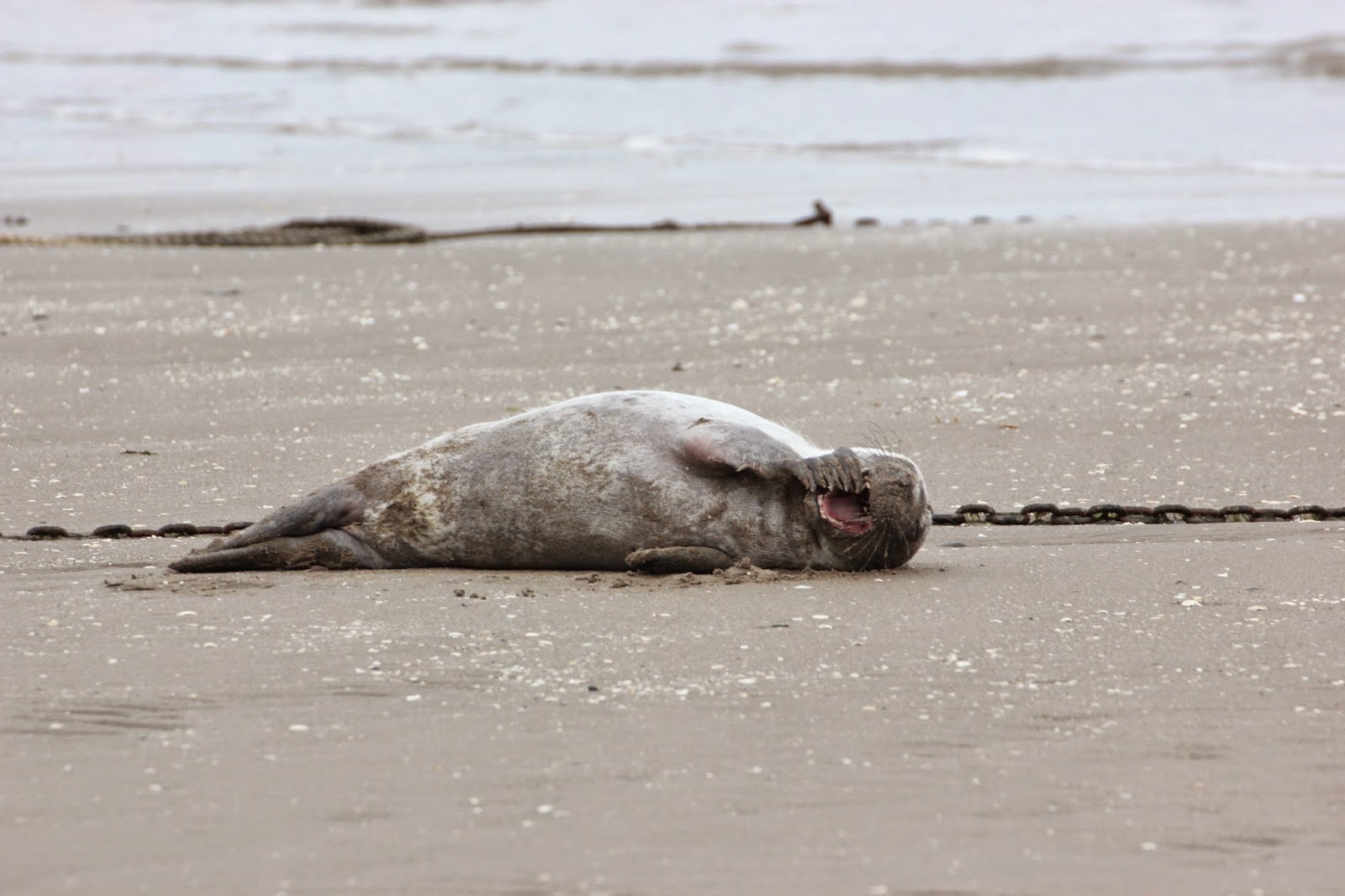
I usually need a nap after a tough swim too

Don't approach the animal. They are adorable, but will bite and beat you easily. And they have seriously nasty diseases.


And take lots and lots of pictures from that safe distance. Because really... who wouldn't?

Seal ya next time!
Speak Loud!

Monday, September 22, 2014

I Hope She...

Hey Team!

So instead of doing real work, I think it's time for storytime...

Once upon about a month and a half ago, I had the pleasure of sitting out on the harbour wall for 2 hours waiting for dolphins to arrive so I could photograph them.

I was not disappointed. Almost immediately upon my arrival, a mother and calf, two of our regulars, came right up close to the wall, much to the delight of everyone around me. I took photos, made sure they were good, then settled in for the show. I was more waiting to see if they did anything interesting, already having taken photos for actual science.

As I was sitting back down, this little girl, who I found out later was seven years old, starts asking me questions. Who are the dolphins? Is it a mom and baby? Where's daddy? I showed her the pictures I took, explaining who the dolphins were (Nick (015) and her calf 220, if anyone is interested), and that yes, it is a mom and her calf, and that the dad's don't really spend time with the mom and calf. I felt a little unsure of how to explain polygynous mating systems to a seven year old, but she seemed to understand - or at least accept it - easily.

That should have been the moment it clicked for me. Silly me though, it took me almost the entire hour we sat there - me, her, her parents and her brother - to realize this girl was brilliant. And special. Her interest in the dolphins, the level of questions she asked about them - about their feeding and travelling and socializing - I think back to it and I am amazed all over again. Her father was also taking photos and participating in the conversation, and she matched him in curiosity  and followed the conversation every step of the way. I was completely enraptured by this little girl from Southampton.

The conversation had to come to an end as dinner time approached, but we managed to agree that dolphins are the most intelligent (her word) animals on the planet and one of her favourites. Alongside puppies. And that her wish was to see dolphins while in New Quay, so her wish came true.

Not to be left out, her brother was keen to show me a rather interesting piece of metal he found in a crack in the harbour wall. Buried treasure, just like a pirate, we decided. This was his wish for New Quay. So it was a wish-fulfilling day for the whole family.

As we waved goodbye, I felt completely blessed to have been out on that wall that night. We meet a lot of people being out surveying for dolphins, photographing them, but usually it's a passing question, a quick story. This was a life moment for me.

Now, people who know me know I love kids. I've been working with them since I was twelve, and have never regretted a moment of it. I remember how I felt as a kid, looking up to the grownups around me, soaking up all their attentions and lessons.

I feel silly and a little vain saying this, but I really hope this little girl remembers me for at least a while. I want to be someone who she remembers alongside the dolphins. I hope she never forgets the feelings of awe she had seeing them.

I hope she never loses her curiosity. I want her to grow up questioning everything around her and always wanting to learn more. I don't want people to sugar-coat her world because she is strong and smart enough to understand that not everything works in nice, appropriate units.

I don't want her growing up feeling like humans are the most superior species on the planet. I want her to remember that there are so many ways to measure intelligence and that just because we do a lot, doesn't mean everything we do is right.

I'd love to randomly come across a profile of an up and coming marine biologist in 20 years time and read about a woman from Southampton who now works in marine mammology, but I doubt that will happen. It would be too much to inspire her to follow the same path as me. But I hope I did inspire something. Or that the dolphins did.

Maybe they'll go home and buy her a book on dolphins. Let that be a gateway book to books about the ocean, the rainforest, the planet. Let her delve into the world around her, under her, above her.

I can't believe the emotions I am getting just writing about her. This little girl, one exactly like so many I've met before, will have a lasting impression on my memory and my heart.

May she grow into the woman I truly believe she can be.

Speak Loud.

Friday, September 19, 2014

After a whole week

Took my first photos of dolphins in exactly a week. Forgot how good it felt. Also, I still can take a decent photo. Thank goodness!

Speak Loud!

Saturday, September 13, 2014

Marine Mammal Medic Course

Hey Team!

So last weekend a bunch of my friends and I took the Marine Mammal Medic Course with British Divers Marine Life Rescue. They are an organization for the UK and Ireland that are basically strandings response. If a seal, dolphin, porpoise or whale wash up on the beaches of Britain, you call their hotline and they send people (now) like me out to (hopefully) save them. They have an extensive volunteer web complete with locals, scientists and marine vets who all just want to lend a hand when they can.

Now, once I leave the UK I won't really be able to be part of their volunteer base. But I took the course to get stranding training, because every little bit helps. I have a basic understanding of what to do for a stranding and what is needed, which will look much better compared to someone who has no idea where to even start off.

Every country, province, state, county, what have you, will have a different way of responding to strandings based on resource availability. But knowing something, anything, is better than knowing nothing.

It was a one day course. the first half was lectures - how to identify marine mammals, and the theory for a seal, dolphin, small whale and porpoise rescues.
Lectures on Strandings

What to do with a mass stranding (more than one individual)

After lunch was the fun part - we got to practice a seal, dolphin and pilot whale stranding! Now obviously we couldn't use real animals, but the inflatable versions were just as fun!

With seals, like most injured animals, they can get mean and defensive. The main thing is to keep control of the head so you don't get bitten and diseased. True story. Control the head while you check vitals and injuries, then either put it back in the water or crate it and take it to the closest rehab centre.

Throw a towel over it's head to keep it calm and to keep control

Dolphins need their skins kept wet and cool - so make sure to keep wet sheets on them constantly. Check for injuries and make sure a vet takes a look while you monitor vital signs. If the vet gives it the okay, haul it back into the water, and release it when it has the energy to go!

Taking the dolphin back into the water (Photo courtesy of James Bailey)

Small whales (but larger than dolphins) need to be refloated using pontoons - because you try carrying a two tonne animal. Keep them wet and cool, check vitals, get a vet to give the okay, then inflate pontoons around them and release them back when they're ready!

Stabilizing the whale for the vet's inspection and refloatation (Photo courtesy of James Bailey)

setting up the pontoons for refloatation (Photo courtesy of James Bailey)

Obviously this is a watered down version of instructions, but I think it gives you an idea.

"Baywatching" out of the water (Photo courtesy of James Bailey)

If you have the opportunity to take a strandings course, I recommend it. You never know what kind of situation you'll find yourself in working with marine mammals, so it's best to be prepared. Plus it looks great on a CV, and there seem to be quite a few strandings jobs open at any given moment.

It was a fun day with good weather and good friends. I'm so lucky I had this opportunity here in Wales.

Research volunteers turned marine mammal medics!


Speak Loud!


Tuesday, September 9, 2014

300 Photo Encounters!

Hey Team!

Today we here at the Cardigan Bay Marine Wildlife Centre and the ShoreFin team (A.K.A. my boss and I) have photographed dolphins 300 times!

It's a pretty big deal - last year they didn't even break 100. Not every encounter had good photos (I blame myself) and not all of them were from land - but 300 is a lot for the first official year of the project!

And of those I have my fingerprints on 117 - I'm delighted!

Here's to many more before I have to leave.

In celebration, here are photos of dolphins.


Check out more on facebook!
 
Speak Loud!

Friday, September 5, 2014

Dolphins from the Water

Hey Team!

So after MONTHS of being grounded, I was finally back on the water last Tuesday! I know how it sounds, but it felt so nice being back on unstable ground.

Myself and most of the other volunteers took the day to go on an 8-hour boat trip down the Welsh coast.

It was a beautiful day. A little windy, but it gave the trip character. It also made dolphin spotting difficult.

So when the volunteers take data on a boat survey, they have to keep track of the boat track, weather conditions and of course any marine mammal sightings they might see.

It's a lot of work! I did it for about an hour and a half and man, just trying to tell if the boat sped up, slowed down, moved left or right enough to change it's track, it's stressful! The others who have a lot more experience with it than I do told me I was over thinking it, but you don't want data to be wrong!

When I wasn't worrying over data, I was either just enjoying the boat trip or sitting up high in the "crow's nest" trying to spot dolphins.

Not an easy task. I hate trying to spot dolphins in a fast moving boat. I mean, they're moving, you're moving - how can you look everywhere? What if they pop up just after you've scanned a section? Now that section is behind you, and you're looking forward.

So much to think about! I'm the worst dolphin spotter off of boats, although no one was really seeing much. I think the dolphins I did see were a fluke (pardon the pun) or someone else saw them first, I was just louder. I have no confidence in my dolphin spotting abilities.

Probably not the best thing to admit to the world, but this blog is supposed to be honest, and it's a weak spot in my skills that I'm trying to work on.

Anyways, when we did finally see dolphins, see dolphins we did! We had no fewer than 6 dolphins around our boat each time we did see them, and did they put on a show! Splashing, leaping, bow riding. They came so close to the boat you could see them swimming underwater! So many dolphin faces!


Everyone else on the boat was oohing and ahhing, - and I'll admit I had a"wow" moment when three of them leaped out simultaneously - but I was focused on taking decent photo-ID shots. Between myself, one of the more experienced passengers, and my two bosses we walked away with a hefty amount of photos for me to sift through and see who we know was around. A couple individuals were pretty obvious - 367, 032 - but some are complete mysteries! Makes the day even more exciting!

Dolphin leaping off the Welsh Coast


There were some interesting birds out and about, or so I'm told. I wish I could muster up more emotion about birds, but I seem only to be interested in penguins at the most. Oh, and we saw a little seal pup on our way back to port!

Right before a tail slap


So it was a good day. The wind went wild in my hair, I was in 4 layers of clothes, my bare feet were freezing, my pant legs soaked, but it's exactly what I needed. Utter perfection.

Speak Loud!

Wednesday, September 3, 2014

Museum in Review: Oxford University Natural History Museum

Hey Team!

Two weekends ago I had the pleasure of visiting Oxford, England for a short afternoon. I was dashing around the city trying to take in the sights, but one thing I couldn't rush was my visit to their Natural History Museum.
The Oxford University Natural History Museum


Now, I think I have an obligation to visit every NHM I can in every city that I visit. I've been to a few already, and rarely am I disappointed. Oxford was no exception. Even with some infamous museums within it's radius (see the National NHM in London), the Oxford museum definitely held it's own.

And goodness, did it feel British! As modern as it is, between the building itself and their setup, it might have been the 1800s still - lots of glass cases and labels, and some of the specimens have been on display since it opened!

Oxford as a university has been around since before 1100 A.D. So it's been there for a while. And during its reign it has educated or played home to some of the greatest minds in history. Especially for natural sciences.

So it comes to no surprise that The NHM has quite a few nods of appreciation to quite a few of these gentlemen. One of the most noted being Charles Darwin, who's Origin of Species was greatly debated in 1860. They had an excellent and informative display about evolution and Darwin's theories, as well as some fun facts about the man himself - everything a budding biologist would want to read and hear on a trip to a museum!

***

Some other fun things I saw and read at the museum:

Dodo

They have a stuffed dodo and it's skeleton on display the museum. This was my first dodo! They really are ridiculous looking birds - how depressing that they are extinct! I feel like the dodo display has been around since forever, but it would have been nice to see more about modern examples of extinction.
Dodo! Skeleton, cast of legs, and taxidermy specimen


Dinosaurs

I know you don't have to travel all the way to England to see a T-Rex skeleton, but while you're here, you should come check it out! And who knew that so many dinosaur fossils and bones have been found in England? I didn't, until I came to the museum!
T-Rex! Roar!


Marine Mammal Skeletons

Okay, so obviously I just love these, but they have a bunch of skeletons in ascending size hanging above your head - they don't have room for the biggest of the big, but their collection is still impressive!
Marine mammal skeletons - from bottlenose dolphin up to minke whale

Alice in Wonderland

Did you know the Lewis Carroll was a deacon at a church in Oxford, and a student and Professor at the university? I didn't, until I came to Oxford. They are very proud of it, so much so there is a display at the NHM with all the animals mentioned in his various Alice and associated books.

The white rabbit in the corner is always late
Tactile Displays

Okay, sometimes I am so much a child at heart that the instant I see a "Do Not Touch" sign I have an intense need to touch it. I manage to control myself but man, does it hurt!

Not Anymore!

The Oxford NHM knows that kids and grown-up kids alike have this strange need to touch things. So along with all the objects behind glass and railings, they have some out on the floor that they actually ask you to touch! Dream come true! Probably some of them are casts or replicas, but the stones, some of the fossils and definitely the animals were 100% real and I touched them all! As someone who has worked in a museum I know how much touching things is very, very bad, so it's a major bonus when a museum has things out (that clearly aren't too valuable or can't get easily damaged) for the public to play with. I was as giddy as the 6 year old I was following behind, just touching it all.

That's me touching an ammonite fossil!
**

Obviously this is just the tip of the iceberg. It's not an overwhelmingly large museum, but it has quite the collection. I know my reviews usually just focus on animals, and even then primarily mammals, but their plant, bird, insect and rock and mineral displays were equally impressive.

Insect display
If you are in Oxford and looking for a way to enjoy a few hours indoors (just after leaving I was caught in a flash storm - that would have been a good time to be inside!), I highly recommend the NHM. You'll see amazing specimens that have been on display for centuries right alongside recent discoveries. You'll learn a bit about England and a lot about the world. You'll see a museum at it's best and best of all, you'll see it for free!

So thank you Oxford University Natural History Museum, for a perfect finish to a perfect afternoon in Oxford.

Speak Loud!

You can visit their website and get all details about the museum here

Thursday, August 28, 2014

A New Twist on an Old Favourite

Hey Team!

So I have now spent almost three months in New Quay, Wales working on a new and exciting project with the Cardigan Bay Marine Wildlife Centre. How about a little backstory...

Let me take you back to March 2014. I received an email inviting me to interview for a project officer position for a new bottlenose dolphin photo-ID project. The tasks: get the project up and running, run it for the season, write reports and set it up solid for next year.

The interview went well. I have good experience with dolphin ID, done report writing for university, and I've used fancy cameras a couple times in the past.

Only problem? They needed me to start  in like two weeks. I didn't think I could pack up my entire life in Canada and move to Wales in two weeks. Also, the summer season was longer than the six months I'm allotted to be in the UK. They told me they'd get back to me.

Get back to me they did. They couldn't offer me the original position, due to all the time constraints crossing an ocean brings, but they were willing to make up an assistant position for the project, just for me! I couldn't say no.

Two months after that, two planes, 3 trains and a bus later, I was in Wales. It's been a helluva ride so far, and I am starting to actually get depressed that my time is almost up.


So what exactly are we up to here?

Well the project that I'm working on, ShoreFin, is a land-based dolphin photo-ID project. In New Quay, bottlenose dolphins very often come in close enough to shore that with a long enough lens, you can get ID quality photos without having the interact with them on the water. In the past the centre has only taken opportunistic photos from boat trips, but this year is the first year there are people completely dedicated to taking photos of dolphins from land.

The volunteers from the centre do shifts on an all-day survey for dolphins from the harbour wall in the village. When they see dolphins close enough to the wall, they call for either me or my boss over the walkie-talkie and we grab our big, expensive camera (seriously, the lens costs more than all my possessions combined) and we head down to meet them. Once there, we hope and pray and with a little luck we take a decent photo of a dolphin fin.


Then we take these photos into the office, write up some notes on the encounter, label everything and then the fun begins. Matching.

Now, I've talked about matching dolphins in an earlier post. Most dolphins, through social interactions, foraging mishaps and run-ins with humans, can get nicks, notches and cuts all up and down their dorsal fins. We use these imperfections as a fingerprint to identify one individual from another. Although their fins can change year to year, we manage to figure them out time to time.  Though the catalogue is much smaller and doesn't go back quite as far as the Sarasota Dolphin Research Program, the monotony of matching still stands. And it will always make my eyes go cross-eyed. But this time there has been a much better chance of me actually matching dolphins.


This is the coolest part though - when I was in Florida, I was amazed that my supervisors could tell the individuals just from seeing them in the field, through the lens of their cameras. They were ID-ing individuals in the field, rarely ever needing to check. I was awed by their memories and abilities, and I completely believed I'd never be able to do such a thing.

Well, not that we have nearly as many regulars here as Sarasota does, but more often than not I can ID our 20 or so regulars in the field. A couple mom and calf pairs, some individuals that come in and out. Some we don't have numbers for (or maybe we do and we just haven't matched them yet), but their fins this year are recognizable. All I can say is that I am so surprised at myself for actually not needing photos on a computer to compare fins to. I know who these bad boys (and girls) are just by a close up in the camera lens.

Dreams do come true folks. And you can learn the skills you once thought only gods possessed.


This has been an amazing opportunity. For the first time I'm not just a standard intern. I have an official title (Assistant Project Officer doesn't sound too bad, does it?) and when my boss is on vacation, I am actually in charge of the project. It's been a chance to have so much more responsibility than I've had in a long time, and it can only get better from here. This has been so much more than your average internship, and it's an experience I'll never forget.

But it's not over yet! I have two more months to put my stamp all over this place!

One more dolphin pic, for good measure.


Speak Loud!

Follow along with the centre at their facebook page here
Follow along with the ShoreFin project at their twitter here

Wednesday, August 20, 2014

I Live, I Promise!

Hey Team!

Wow, I am so, so sorry. I didn't realize it had been actually forever since I have lasted written. I knew from the get-go that I was not great at the whole blogging thing, but almost a year is completely ridiculous. Especially because this blog is supposed to be where we chat about all things marine-y (not a word).

From October to the end of May I was home on the prairies, dying to get back to a coast. I travelled a little, worked a lot, met new people and maintained a solid social life, but I was so far removed from biology that I wanted to claw my eyes out at times.

I got a little down, so I wasn't as keen to write. But that makes almost no sense. I got lazy. Them's the truth.

But I'm back now and I will try my best to keep this up better. I'll throw in some back posts to fill it in and go forward from here as best as possible. I'm back in the game full force and doing what I do best - researching animals that live in the ocean.

Everyone aboard!

Speak Loud!

Sunday, July 6, 2014

Third Time's the Charm!

Hey Team!

Another year down! I know this one was a little quieter - believe me, I'm as unimpressed as you were - but the point is to always push forward. I'm in the middle of an amazing opportunity and I'm loving and living life everyday.

May your year be filled with chances, as wide and deep as the ocean.

And whales. May it be filled with whales.

Are you ready for Year Four?

Speak Loud!

Wednesday, January 15, 2014

PUBLISHED!!!

Hey Team!

I AM PUBLISHED!!!
 
After two long years of writing and editing and writing and editing, and not writing, then writing and editing and writing and editing and.... well you get the idea...
 
I have PUBLISHED my research in an honest-to-goodness scientific journal with an honest-to-goodness official sounding name!!
 
Along with my thesis supervisor and the veterinarian from the local zoo, we successfully turned my honours thesis into a journal article which was accepted to the Canadian Journal of Zoology.
 
There was a bit of crying and a lot of jumping around and a lot of celebratory dancing that went along with the publication.
 
This is also a chance to thank everyone who went on this crazy journey with me. Put up with my insanity while writing the thesis, edited the paper over and over without calling me an idiot too many times, and for some helped me through some breakdowns where I truly believed I couldn't pull any of it off.
 
You can find a link to the article here. If you don't have access to the journal (and I don't really expect you to), and know me personally and want a copy to read, I can send one your way. I can't promise you'll understand much, depending on your background, but I love to answer questions almost all the time.
 
Speak Loud!

Tuesday, November 12, 2013

"So, When Do We Move On From This?"

Hey Team!

Sorry for the silence. Being home has been quiet. Too quiet for me. I've gone back to old jobs, picked up a new one, but I am feeling very much liked a beached whale - out of my home element and slightly crushed beneath the enormous weight of my future.

It's only been just over a month since I've been home, but I am feeling super out of it all. I'm hoping not to do another internship, but jobs are scarce and competition is high. And grad school opens a whole new can of questions about the who, what and where of it all.

Sometimes it feels like it would be so much easier to do... well, pretty much anything else.

Which some people in my life seem to think is the next step. Rather than just sitting back and letting me do my thing (which I am trying to, really I am), there are people in my life that still seem to think that this is a phase of my life.

I joke a lot about how people always say to me "I wanted to be a marine biologist when I was a kid" when I tell them what I do. Most kids go through a phase where they want to connect to animals as their dream job. But they grow up and turn towards more suitable jobs that family, friends or general society tell them would be better for them.

So I think some people believe that I'm just still in that kid phase. That one day I will grow up, snap out of it, put on the suit and head into an office or a operation room or a class room for the rest of my life.

So I was talking about my current predicament and someone who I always thought understood me and my life says, in the straightest of voices, I swear to you, "So, when do we move on from this?" meaning  - when do we give up on this whole marine biology dream and do something worthwhile with your life?

Let me tell you - there is no moving on. There is nothing more worthwhile. I may never own a house or go on expensive vacations or be able to retire at a reasonable age, but I don't really care. Because I am going to wake up every morning in whatever shack I end up living in, and want to get on my bike and go to work everyday until I die because there is no plan B.

This is my life. Either get on board or jump ship. Come Hell or high water, this captain will sink or swim with her ship of dreams.

Enough cheesy water lines,
Speak Loud!

Thursday, October 3, 2013

Hi from Home!

Hey Team!

So I'm back home on the prairies :( The season is coming to an end for MICS, and they figured they would send me home when they planned, because there wasn't enough god weather days to keep me on. I learned so much while I was out there, about whales, research and most importantly about myself and where I want my future to lead.

The biggest thing is that I think I might be done with unpaid internships. I have loved my life the past two years, if my posts are any indication about how much fun I've been having, they are nothing compared to real life. But at a certain point you realize that you want certain things in life - like not living with your parents - and those things cost money. Money you can't make if you're not getting paid.

So now I have a couple choices - I am applying for jobs as they come up, and working part time at home to feed my fun and friend addictions at home, as well my travel addiction on a more minor level. I have to figure out if I want to get a full-time-rent-paying job here in the city not in my field, or just putt around until something related shows up.

With all the dumb luck I've had over the years, maybe the opportunity will come up sooner than expected. Until then, this blog will hopefully be updated with reviews of movies, books, tv shows, as well as anything else that sparks my interest. It's constantly evolving and changing, just like me!

The weather is getting colder, I sure wish I had a layer of blubber sometimes. Stay warm both on and off the water!

Speak Loud!

Wednesday, September 25, 2013

Mega-Facts on Megaptera

Humpback whales are some of the most popular, most celebrated and most studied species of whale on the planet. Here are some fun facts which totally validates all that.
  1. Their scientific name is Megaptera noveanglia - meaning "Big-winged from New England". We're very creative.
  2. They are a rorqual species of whale. The group is defined by the large grooves on the bottom of mouth, allowing their mouths to open like an accordion.
  3. Humpbacks have longest pectoral fin-to-body ration of any whale - up to one third of their body length.
  4. Why so long? Long fins allow for graceful manoeuvrability under and over the water
  5. They love to breach! Breaching is a fairly common whale behaviour, where the animals throw themselves out of the water and come crashing down. There is no sight more amazing. I had the chance to watch one breach something like ten times in a row - utterly spectacular.
  6. The 'humpback' in their name comes from the hump-like dorsal fin on most individuals, as well as small humps along the spine between the dorsal fin and tail.
  7. They migrate! In the summer they inhale as much food as possible in cold northern waters, then they head south for the winter mating and breeding season.
  8. Humpbacks are probably best known for their mad singing skills! They are the only whales to properly "sing" - in tune and everything! Only males sing though, and only at the winter breeding grounds.
  9. Researchers are pretty sure it has something to do with mating (because what isn't, really), but nothing is definitive. Some think it actually has more to do with communicating to other males than with females.
  10. In the summer they eat a lot  of krill and small schooling fish (capelin, herring etc.). Unlike some of their relatives, humpbacks aren't really picky eaters!
  11. Humpbacks also have one of the coolest ways of catching fish! In a group effort, they'll blow bubbles out of their blowholes to surround and ensnare schools of fish, then swim up through the nets to get a good mouthful of fish. This is called bubble netting, and is crazy to watch!
  12. Individuals can be identified using the patterning on the underside of their flukes (tail fins). Each one has a black and white pattern that is unique to an animal. The variation in the amount of white and black is used to ID an animals, as well as the edge of their tail, which have a natural raggedy to them.
  13. They're big animals, about the size of a bus. Which seems pretty big, unless you compare them to the other whales in the rorqual family, which includes the blue whale and the fin whale. Now those are big whales!
  14. the "moles" or "warts" on their faces are commonly known as tubercules - no one really knows what they are for, but they have little hairs on them, which makes scientists think they are sensory, and might help them with the search for fish.
  15. As a big whale species, they used to be a target of the whaling industry. While whaling of humpbacks is banned in most places, some countries still hunt them, but in very small, highly managed quantities
So there you go! Some things to keep you interested in an interesting species of cetacean!

Sunday, September 22, 2013

Minke Stranding!

I sort of feel kind of guilty for how exciting today was, because sometimes I think "dead whale" shouldn't make me a happy as it does, but today, it kind of did. I might be a bad person.

Anyway, today there was a stranded minke a little west of us, and MICS is the stranding response unit, so we got to go check it out!

Size has become such a relative thing. In reality, minkes are big animals. Like, probably 2 cows worth of animal. But compared to seeing humpbacks and fin whales, I knew the animal we saw was "tiny". Oh what a life I lead.

So we got there, and it's pouring rain. Makes it hard to take any kind of notes in the rain. Fortunately the rain did stop eventually, but not before getting every piece of paper we had sopping wet, and all the sharpies stop working. Oy.

We got there, took the total length measurement of the minke, then started taking our samples. Eight samples of muktuk (blubber and skin. They don't call it that here, that's just what the Inuit call it) from up and down the body, an entire jaws worth of baleen, plus a little bit of skin for isotope analysis. An extra sample of muktuk and a piece of our baleen for DFO, and we called it a day. It was a quick response because the rain made it impossible to take lots of measurements (we really had nowhere to write them down) and a little animal like that didn't need a whole lot of samples taken. A whole bunch of photos though, while praying that the camera doesn't get too damaged in the rain.

I didn't get to touch the minke (wah!) because I was taking photos of the samples, and you need clean hands to touch the camera.

We left it there, and hopefully the seagulls will help with the decomposition process. I'm not quite sure if they'll do anything with the body or just leave it up to mother nature.

All I know is I smell, my clothes are in the wash, my rain jacket might never be the same, and that is the biggest dead animal I have ever worked with. Can only go up from here!

And on a totally random note, I got my first ride on an ATV today! It was kind of fun, I have to admit!

Due to the nature of the photos, and I'm not sure if I'm allowed to post them because of fun people like PETA, I'm not putting any photos of the minke up here (I really don't want to get in trouble!). Sorry guys!!!

Speak Loud!

Saturday, September 21, 2013

Conservation vs. Research(vation)

Hey Team!

This post is actually a year in the making. Because last year I did an internship with a conservation group, rather than all my others, which have been research based.

And there is a big difference between the type of work they do, and the people who do it. And I sort of wanted to touch on those differences here. Because research work isn't for everyone, but neither is conservation. So maybe use this as a way to help decide which is right for you (if, you know, you're reading this as a way to help continue your future in marine biology).

So, research. It's about asking questions. Keeping up with the latest news in the field and figuring out what the next step is in the pursuit of knowledge. Most biologists are just trying to figure out the world around them.

Conservation is about doing something with the answers that researchers have found. It's one thing to find out that whales are sick but what are we going to do about it? As the world is being figured out, we need to put that figuring into action.

The people are different as well. To be a biologist, you probably need at least one degree in, you know, biology. Do to research, you probably want a one of those too. At least some kind of science degree is a must. Chemistry, physics, geology, all important.

Not for conservation. Anyone with any background can do conservation work, though it would help if you had some bit of background in what you are conserving, but you don't need an entire degree for it. Marketing and business, law, even an arts degree is completely okay if you want to go into conservation. In fact, different background of education mean that people bring different ideas towards their conservation efforts, which can be useful!

This next one is very generalizing, and not true for each and every researcher, but for the most part, researchers would rather not deal with the general public, at all. They'd even rather not deal with other scientists every once in a while. But they have to, mostly for funding reasons.

Conservationists have to deal with the public on a regular basis, so they should probably like it. A big part of wildlife conservation is prevention and awareness - letting people know what they can do to protect their local (and global) wildlife. It's also fundraising, petitioning, rallying - all having to deal with ordinary people on the street. It takes a particular kind of person to be able to swallow retorts as the ignorant come out of the woodwork. So unless you have a strong filter on you, I'd stay away from conservation.

If you're going to go into research, don't do it because "you love whales" or "always wanted to see a killer whale". Do it because science fascinates you  Do it because you want to know more. This isn't an ecotour of whales or the safari or the rainforest. This is real work. For some, it doesn't matter what species they work on, it's the techniques and the methods that they care about. That is research.

That isn't to say that researchers don't love their research species. Some of the best really do. But it's more about what we can learn from them, rather than the "prettiness", "cuteness" or "coolness" of the animal.

I've known since before I can remember that I want to work with whales. I've known since second year university that I want to work with blue whales. But that's not what any potential Masters supervisor cares about. What they care about is my skill set, and my determination to do science. Any science, so long as it's science.

Conservation is begging for passionate people. Save whales because you love whales! Stop the poaching of elephants if you love elephants! Get involved because where scientists need to keep some professional distance from their research species, conservationists get to put all the emotion into it, because that's what interests and holds an audience captive!

I want to end on things they have in common. It's the people who are most passionate about nature and the world around them that get involved in both. These people, for the most part, love hiking, camping, eating organically and locally, and just being outdoors as much as humanly possible.

They are also in it for the animals. Although almost all the funding comes from "how does this affect humans" kind of sources, they are really all in it because of the animals, and because this Earth would be a pretty awful place to live without them.

Another thing they have in common - there is no money to be made in either. If you promised your mother you'd find a job that would keep you comfortable for the rest of your life, you better get out now.

If you promised your mother you'd find a job that tried to make a real difference in this world, then stick around and get ready for ramen.

Speak Loud!

Thursday, September 19, 2013

Go Greased Lightening!

Why do my hands feel so greasy and why do they smell so weird?

Kidding, they don't, I've washed them a bunch of times, but they did for a while there because I helped clean the boat stem to stern so we could put it away for the winter. So much grease and scrubbing and taking apart of things.

Even if it was cold and grey out today, a perfect day to stay indoors curled up with blankets, being out and active was so much better than being inside in front of my computer. I started with some photo matching this morning and could barely see straight, so I am happy that most of my day was spent being busy, albeit cold and wet.

Speak Loud!

Monday, September 16, 2013

A Little Info Fo' You!

Hey!

So, it's so sad to think about, but I'm soon going to have to go home. I know, I'm crying. But before I go, I think I should tell you guys a bit more about where I am at.

The Mingan Island Cetacean Study (MICS) was founded in 1979 by Richard Sears, who was originally in the St. Lawrence estuary to study salmon, but then noticed all the blue whales in the Gulf. Like the rest of us, he was hooked.

Soon after he figured out how to identify blue whales by their mottling pattern on their backs. Yes my friends, this guy invented a way to ID blue whales. And so MICS was born. It used to be just a little museum in the living room of a little blue house (where the team lives now), and now, in Longue-Pointe de Mingan, it's a large research station, shared with Parks Canada, with research offices upstairs and a beautiful museum downstairs.

As a source of income, MICS does interpretations in the museum, where the public can come in and learn all about the rorquals of the Gulf of the St. Lawrence and the research that we do. We invite them to ask tons of questions and learn as much as we can teach them. Awareness is the first step to change.


After (or before) their interpretation they can peruse the boutique and buy something either very cute, very beautiful or very cheesy that has a whale on it.

Now, I love museums. And talking. And teaching people. So this seems like it would be perfect for me, right? Yes... except for the fact that all the "public" they get in are French. So, not so perfect for me. I just get to stare longingly at the museum and hear it whimper "Interpret me, I'm so lonely...".

Okay, I might be going a little crazy. Well, crazier. I'm already pretty far gone.

I don't want to spoil too much of the station because, well, everyone should spend so many hours getting here to get the interpretation in person! And if you're my friend you probably want it in English! Yay!

Speak Loud!

Friday, September 13, 2013

When the Sky is Grey

Hey Team!

So the title of this post is a little misleading - we don't just to office work when the skies are grey and cloudy, that would mean a lot of office days! In fact, cloudy days are some of the best days to get out on the water, because there's no sun for that horrible glare!

But on days were it's too windy, too foggy or too rainy to be out on the water, we head over for a day in the station.

There are a bunch of things I've gotten a chance to work on here, and I'm going to try to explain them.

First, data:

The work here has been going on for a long time, and there is a lot of data. Data from the boats, data from the biopsies - a lot. So as often as possible, a couple people sit down and put all the data that was recorded on the water, which has already been transcribed into logbooks for the shelves, into digital data to be stored electronically. I don't think I've ever known a project to be up-to-date with data entry, and this one is no different - we would like to finish 2008 before the end of the season.

Second, photos:

This one is has multiple parts. First there is always matching. Always. I explained in this post what sort of photos we try to take, and while time individuals are known straight away on the water, there are lots that aren't, and we have to figure out if we already have them in the catalogue or if they are new individuals. It's rather a subtle art, one that I am in no way perfect at, but once and a while I get it totally right (like here). Which means I'm learning!

Second, up until about 2007, most of the photos taken here were film. Which means that they had to be developed and stored. Now with all our fancy-schmancy technology, they are scanning in the negatives from decades past and storing them digitally, so we can actually try to use them for matching.

I need to say though, that some of these photos are just horrible to look at, I don't know how anyone could see the small details that differentiate one whale from another, but they do and they did for decades before I cam around. Those are the true artists, my friends, true artists.

Back on topic though. So negatives have to be scanned and labelled, and all the information about the photos have to also be stored on the computer. Which means sitting with the negatives and the logbooks and making sure everything lines up pretty. It takes a lot of concentration and a lot of time to make sure you don't miss information, but once it's done, it's done!

Usually one of the main jobs of interns here is to do interpretations of the museum that they also have here. It's an awesome place, I'll try to write about it next week (I want to take pictures for the post!), but because it can't get any more French then where I am now, I have been practically useless in the museum. Interns also usually work in the boutique and help set up day trips (people who come out on the boats for one day, and get to watch us do our research. Sort of like whale watching, but with more science!). But again, as a very deeply rooted Anglophone, I am useless. Plus it's the end of the season, so the day trips have ended anyway.

The others here, sometimes interns included, usually have other projects that they are working on as well, so that fills their time. As someone with a very unstable future and limited means of figuring things out, I have had a bit more spare time around the lab to do personal things, like write this blog!

So the station days aren't the most exciting or most interesting, and sometimes I am so happy for the invention of the internet and all it's means of procrastinating. But it comes with the territory of scientific research, and at least I can look forward to the day I'm back on the water again.

When I try to explain to people why I do what I do, one of the things I say is I can't imagine life at a desk job. But then I have to remind myself that 80-90% of this job is a desk job. But I think in part it's what we get to do at our desks that can make it so cool - learn and discover new things. And then of course there's the big wall calendar (or the countdown that a calendar would symbolize) that let's us count down the days until we are back in the field again. The adrenaline of being out on the water helps carry you through the desk days.

Speak Loud!

Thursday, September 12, 2013

Matched a Blue!

I matched a blue whale today! From the Baja catalogue, for a scientist that wants to see if we know any of the blues he's been studying.

BB006. I finally got a chance to feel like I know what I'm doing!

Speak Loud!