Hi Everyone!!
Wow, it's been a while! Sorry, but April was pretty boring. Finished up on inventory (I looked at over 7200 samples. Oy.) and I just finished helping out on some data conversion (I might post about that in the future). But in terms of Marine Biology, it's been a quiet month.
Until Now!
I have been accepted as an intern with the Cetus Research Society for this summer! It's out in Victoria, BC, Canada and I am so excited to (finally) get out to the West Coast and live like a hippie (kidding). The internship will get me out on the boat but also talking to people about killer whales and the impacts of boating. I'm really excited to get experience in both aspects.
So keep your eyes peeled starting in a couple weeks for updates on my adventure!
Speak Loud!
Friday, April 27, 2012

Tuesday, April 3, 2012
It's a Mans World... Or Is It?
Hi Everyone!
This might seem a little out of place, but my grandmother sent this video to me because it reminded her of me, and not to seem conceited or anything, it reminded me of myself as well.
Science has always been a mans world. It seems like only within the last generation or so am I reading women names in my journal articles. It's no surprise that the farther up you go in the chain of research, at the end of it all you are more likely to find a man than a woman.
But it's changing, and I am one of the many trying to change it.
When I was finishing grade 6 and figuring out where to go for middle school and potentially high school, my dad was pretty adamant about placing me in an all girls school because, he believed, there would be a better chance of me getting a strong education in math and science, because he understood then (and I definitely didn't) that math and science is a mans world.
But my love of theatre, my ambition for challenge and my preference for public school won out in the end, and I don't think my education suffered. I lucked out with amazing math and science teachers that certainly but no emphasis on gender in the classroom, and I won't deny that the female population in all my classes kick butt. But looking back, I understand and appreciate my dad's worries. Especially because he thought I was going to be a doctor (just kidding... I think).
I grew up in a house of feminists. Go get a copy of Cat in the Hat right now. Read through it. Notice how Suzy doesn't say a single word of her own? Her brother talks for her the entire time. This is not the story my sister and I grew up with. It wasn't until we were reading on our own did we realize this, because my dad had an extraordinary habit of giving lines to Suzy. That's the house I grew up in.
So ladies, it's time to break barriers. Yes, our grandmothers did their share, so did our mothers. But there are still walls to take down, and we don't need to call a man in to do it. I am young and naive and I know it, but I do think I'll be able to have a hectic, life-sucking job and still be able to raise a family the way I want to.
Anyways, this video. Basically saying all the same things I was brought up to believe, but by a woman who has done it. I enjoyed it so much, and I hope you do too. For any men reading this blog, I think you can also enjoy it, and think about what she says on what true equality is in a relationship.
Speak Loud!
This might seem a little out of place, but my grandmother sent this video to me because it reminded her of me, and not to seem conceited or anything, it reminded me of myself as well.
Science has always been a mans world. It seems like only within the last generation or so am I reading women names in my journal articles. It's no surprise that the farther up you go in the chain of research, at the end of it all you are more likely to find a man than a woman.
But it's changing, and I am one of the many trying to change it.
When I was finishing grade 6 and figuring out where to go for middle school and potentially high school, my dad was pretty adamant about placing me in an all girls school because, he believed, there would be a better chance of me getting a strong education in math and science, because he understood then (and I definitely didn't) that math and science is a mans world.
But my love of theatre, my ambition for challenge and my preference for public school won out in the end, and I don't think my education suffered. I lucked out with amazing math and science teachers that certainly but no emphasis on gender in the classroom, and I won't deny that the female population in all my classes kick butt. But looking back, I understand and appreciate my dad's worries. Especially because he thought I was going to be a doctor (just kidding... I think).
I grew up in a house of feminists. Go get a copy of Cat in the Hat right now. Read through it. Notice how Suzy doesn't say a single word of her own? Her brother talks for her the entire time. This is not the story my sister and I grew up with. It wasn't until we were reading on our own did we realize this, because my dad had an extraordinary habit of giving lines to Suzy. That's the house I grew up in.
So ladies, it's time to break barriers. Yes, our grandmothers did their share, so did our mothers. But there are still walls to take down, and we don't need to call a man in to do it. I am young and naive and I know it, but I do think I'll be able to have a hectic, life-sucking job and still be able to raise a family the way I want to.
Anyways, this video. Basically saying all the same things I was brought up to believe, but by a woman who has done it. I enjoyed it so much, and I hope you do too. For any men reading this blog, I think you can also enjoy it, and think about what she says on what true equality is in a relationship.
Wednesday, March 21, 2012
Just Do It
I know I sound like a Nike commercial, but it's relevant, I promise.
I can't say it enough times, because it's something that I don't think everyone believes when you tell them: science is NOT glamourous!
This is not CSI, or House, or Big Bang Theory, or another TV show that shows you how cool it is to be a scientist. This is hard work, no pay and nothing to show for it beyond your CV.
And I do it 'cuz I love it.
What brings this warning on? My current task at work is dull with no challenge. I am doing inventory of seal teeth, animal tissue and teeth slides. I go through every sample, note which teeth are missing, and put it all in a spreadsheet.
I've done just over 850 teeth samples (which feels like 1900, because the left and right are separate), and believe me, there are moments when I ask myself "I need a degree for this?"
Welcome to internships. Welcome to science.
90% of successful students, professors and researchers you will meet have had a period like this. Compared to this, photo-ID was fun! But it looks good on a CV, future supervisors and employers will see this and go "she can do the crap work, and do it right." Plus, the more you say yes to your current boss, the better the reference is for the next job.
This goes for unpaid internships. We would all love to get paid for what we love to do, but like the struggling artist in Soho, we need to suffer for our work.
Anyone who isn't a biologist (aka most of my friends) cannot comprehend the idea of an unpaid intership. When I tell them about past/ future plans, the second question they ask (first being "where is it?") is "is it paid?"
My darling friends. If I was getting paid to be a marine biologist, I can assure you: It would be the first words out of my mouth!
An interesting story. I was chilling with some people, talking about my plans for unpaid internships, and a friend goes "I love my work, it's interesting and I can't imagine doing anything else. But if they didn't pay me... I don't think I would do it."
Totally fair. Most people would choose a career that actually pays them. I get that.
But with that attitude, biology with chew you up and spit you out and tell you to be something easy. Like a doctor.*
In my field, particularly marine mammal behaviour, you need to be ready to give up time, energy, money, sleep, food, and most importantly, sanity, to get what you want. Ifs and Maybes need not apply.
So my pupils, I again offer you the opportunity to check yourself. Are you willing to do anything, give anything, to be a marine biologist? If not, I suggest getting into birds. Everyone wants to give money to ornithologists. Just be ready to wake up really early.
Complaining about my job and something to think about... yupp, successful blog.
Speak Loud!
*before I get some scalpels launched at my head, I AM KIDDING! Becoming/being a doctor is not easy, I promise I understand it's a challenge. Please don't poison me and make it look like an accident.
I can't say it enough times, because it's something that I don't think everyone believes when you tell them: science is NOT glamourous!
This is not CSI, or House, or Big Bang Theory, or another TV show that shows you how cool it is to be a scientist. This is hard work, no pay and nothing to show for it beyond your CV.
And I do it 'cuz I love it.
What brings this warning on? My current task at work is dull with no challenge. I am doing inventory of seal teeth, animal tissue and teeth slides. I go through every sample, note which teeth are missing, and put it all in a spreadsheet.
I've done just over 850 teeth samples (which feels like 1900, because the left and right are separate), and believe me, there are moments when I ask myself "I need a degree for this?"
Welcome to internships. Welcome to science.
90% of successful students, professors and researchers you will meet have had a period like this. Compared to this, photo-ID was fun! But it looks good on a CV, future supervisors and employers will see this and go "she can do the crap work, and do it right." Plus, the more you say yes to your current boss, the better the reference is for the next job.
This goes for unpaid internships. We would all love to get paid for what we love to do, but like the struggling artist in Soho, we need to suffer for our work.
Anyone who isn't a biologist (aka most of my friends) cannot comprehend the idea of an unpaid intership. When I tell them about past/ future plans, the second question they ask (first being "where is it?") is "is it paid?"
My darling friends. If I was getting paid to be a marine biologist, I can assure you: It would be the first words out of my mouth!
An interesting story. I was chilling with some people, talking about my plans for unpaid internships, and a friend goes "I love my work, it's interesting and I can't imagine doing anything else. But if they didn't pay me... I don't think I would do it."
Totally fair. Most people would choose a career that actually pays them. I get that.
But with that attitude, biology with chew you up and spit you out and tell you to be something easy. Like a doctor.*
In my field, particularly marine mammal behaviour, you need to be ready to give up time, energy, money, sleep, food, and most importantly, sanity, to get what you want. Ifs and Maybes need not apply.
So my pupils, I again offer you the opportunity to check yourself. Are you willing to do anything, give anything, to be a marine biologist? If not, I suggest getting into birds. Everyone wants to give money to ornithologists. Just be ready to wake up really early.
Complaining about my job and something to think about... yupp, successful blog.
Speak Loud!
*before I get some scalpels launched at my head, I AM KIDDING! Becoming/being a doctor is not easy, I promise I understand it's a challenge. Please don't poison me and make it look like an accident.
Monday, March 5, 2012
Lab Rats Aren't Just for Study...
It's been really swell being back at the DFO. I've learned a lot and I've been having fun and it's been great working with old and new friends.
So I'm going to share my lab work with all of you!
Part One: Beluga
I was helping TM with her beluga project. She's looking at whether belugas from different communities are being stressed out or not. So she had me taking little bits of blubber from larger samples of blubber to freeze dry, crush up and analyze. Pretty simple stuff: cut off a bit of blubber, weigh it, but it in a vial and stick it in the freezer. Repeat. It's fatty, greasy work put pretty fun.
Part Two: Bowhead
MC is doing some totally awesome project connecting all the major whale species in the arctic food web, but his primarily looking at killer whales. He took bowhead baleen and drilled into it at 2 cm intervals. He collected the drillings, and then I help weigh out 1 mg samples of each drilling.
This one was tricky. 1 mg is a really small amount, so I was working under a magnifying glass most of the time. And there wasn't a lot of ways to label a really small amount of baleen drilling, so if any mistake made in mixing up samples, you had to start over again.
Part Three: Seals
This has been a lot of fun! I've been taking the lower jaws of arctic seals (ringed, bearded and harbour) and boiling them. It might have put me off watching my grandmother make chicken soup.
Once the jaws are nice and boiled, I take them out, remove all the skin, tissue and occasionally the tongue (those are the best ones!). Then I get out the pliers and pull some teeth!
Who needs to take the DCAT when you can pull seal teeth without a dentistry degree?
The teeth are sent to a lab that takes thin shavings, stick them on a slide and then count the calcium rings to figure out their age.
It's been really gross, totally stinky and completely awesome. My back is aching, my hands are killing me and I've almost impaled my fingers on a canine more than one time. But it's been stimulating work and not monotonous at all.
So that's what I've been up to so far. There might be more, or I might be out of here again! Who knows what the future has in store...
Speak Loud!
So I'm going to share my lab work with all of you!
Part One: Beluga
I was helping TM with her beluga project. She's looking at whether belugas from different communities are being stressed out or not. So she had me taking little bits of blubber from larger samples of blubber to freeze dry, crush up and analyze. Pretty simple stuff: cut off a bit of blubber, weigh it, but it in a vial and stick it in the freezer. Repeat. It's fatty, greasy work put pretty fun.
Part Two: Bowhead
MC is doing some totally awesome project connecting all the major whale species in the arctic food web, but his primarily looking at killer whales. He took bowhead baleen and drilled into it at 2 cm intervals. He collected the drillings, and then I help weigh out 1 mg samples of each drilling.
This one was tricky. 1 mg is a really small amount, so I was working under a magnifying glass most of the time. And there wasn't a lot of ways to label a really small amount of baleen drilling, so if any mistake made in mixing up samples, you had to start over again.
Part Three: Seals
This has been a lot of fun! I've been taking the lower jaws of arctic seals (ringed, bearded and harbour) and boiling them. It might have put me off watching my grandmother make chicken soup.
Once the jaws are nice and boiled, I take them out, remove all the skin, tissue and occasionally the tongue (those are the best ones!). Then I get out the pliers and pull some teeth!
Who needs to take the DCAT when you can pull seal teeth without a dentistry degree?
The teeth are sent to a lab that takes thin shavings, stick them on a slide and then count the calcium rings to figure out their age.
It's been really gross, totally stinky and completely awesome. My back is aching, my hands are killing me and I've almost impaled my fingers on a canine more than one time. But it's been stimulating work and not monotonous at all.
So that's what I've been up to so far. There might be more, or I might be out of here again! Who knows what the future has in store...
Speak Loud!
Wednesday, February 22, 2012
It's Been a While...
Hey Guys!!
Sorry it's been SUCH a long time since I last undated this thing. While working in Puerto Rico I broke my laptop (there were serious tears) so I didn't have all my excellent resources to help me write this!
But now I have it back, I'm back home on the range (AKA The Prairies) and I am in a new position at an old job that I can't wait to tell you all about!
So no, I'm not dead and yes, I am still writing. If by magic my computer still has some notes I took I might have one or two more posts about Puerto Rico, but I am excited to share my work back at the DFO!
Speak Loud!
Sorry it's been SUCH a long time since I last undated this thing. While working in Puerto Rico I broke my laptop (there were serious tears) so I didn't have all my excellent resources to help me write this!
But now I have it back, I'm back home on the range (AKA The Prairies) and I am in a new position at an old job that I can't wait to tell you all about!
So no, I'm not dead and yes, I am still writing. If by magic my computer still has some notes I took I might have one or two more posts about Puerto Rico, but I am excited to share my work back at the DFO!
Speak Loud!
Monday, January 23, 2012
Meet My Friend, Theo
While we all sit around finagling (I can't believe that it's a real word, but it is) with a silly program (more on it later in this post), I figured I'd write my next blog post. Another educational one, on a piece of equipment lovingly called a theodolite.
Never heard of it before? Neither had I until I started applying for internships in marine mammology. Seemingly it was originally used for surveying on land, but someone thought "why can't I track dolphins using it?"
Well... you can, I guess; but it's really really hard.
Too late, it's the thing to do now. Le sigh.
First. Climb up to the top of a high cliff. Make sure you have a clear sight to the water, no trees or tall buildings in the way.
So now you have this theodolite
 |
| Hello, Theodolite |

 |
| Hello, Stand |

Set it up. Make sure it's level. Otherwise steps after this will be harder. Use little bubble levels to make sure it's level.
Using two hands, place the theodolite on the stand. Screw it in. So far, so good.
Now... level the theodolite. There are three levels on the theodolite.
You use the little discs to mirco-move the theodolite up and down until the theodolite (for now on being called 'theo') is completely level no matter which way you spin it. Note: there are two dials on the theo. One lets it spin on the horizontal plane, the other let's the eyepiece spin on the vertical plane.
Okay, turn it on. Spin the eyepiece around until the theo recognizes it (beep!). Then you need to set the horizontal 0 mark. You can use any reference point, but then you have to remember your reference point for the day and it'll change every time. So why not just use North? That way, you can use the same reference every single time! Genius! I wish I had come up with it.
Press the "0 set" button and you're ready to go.
Find something to track. Boat, jetski, surfer, dolphin, whale, whatever. Line them up above or below the white arrows which are set up like a sight of a gun (I had to be told that). Then look through the eyepiece and you'll see a cross hair (now I feel like a stalker/ sniper). The goal is to line up that crosshair at the exact same place on your subject every time.
Now the theo is part binocular, so you can see things in the water from so far away. So as your subject is moving, you can fine tune the eyepiece to follow it as it moves through the water.
It's hard. Like, really hard. Like, ridiculously really hard.
While watching your subject, when it does something of interest, you record the behaviour and the 'location' that is on the theodolite. Then you can use that 'location' to figure out a true location later on (which will come in another post).
That's all there is to a theodolite. In essence, it's an easy piece of equipment to work. In reality, it's a pain that takes years and years of experience to expert. But it's effective and less expensive than tagging whales.
Speak Loud!
Saturday, January 21, 2012
Look at What You're Listening To
Phew! I moment to breathe! And therefore, a moment to blog.
It's been a non-stop whirlwind for the past 11 days. The station is set up, we are trying to find people with boats willing to take us out to look for whales, and in the background, a couple interns are busily trying to find whales in the midst of hundreds of thousands of sound clips.
Yupp, I said hundreds of thousands.
So young padawans, I am going to (try to) explain to you the intricacies of acoustic analysis.
Hydrophones are underwater microphones attached to recorders that are suspended in the ocean by buoys. They record noise at intervals for a specific amount of time, then are brought back to the surface. The recorded clips are downloaded onto a computer, and then analyzed by people with absolutely no time on their hands (which is why they ply interns with free accommodations and a tropical setting).
The clips, in some kind of sound file format, can be analyzed in a variety of ways. One way would be to simply listen to them. All of them. Now can anyone tell me the problem with this?
Let's do a math question: a hydrophone records for a 20 second interval every five minutes for 5-8 months. What would be the length of sound you would have to listen in order to analyze every file created?
I don't even want to do the math. Bonus points for whoever does (and comments below).
So obviously that is a bigger waste of everyone's time than watching grass grow or paint dry. Plus everyone's range of hearing is different, so who knows what one person might miss?
The solution to this is to look at the sound files and find whales.
Wait... what? What dimension are you living in? Seeing sound files?
Calm down! Let me explain...
Spectrograms are a type of image that let's you see sounds over their frequency range over an amout of time. It's a graph, x by y, but each point is so minute and there are so many that it becomes an image. An image of an empty underwater spectrogram might look like this...
If it looks like a lot of mess, that's because it is. The ocean makes tons of noise, and that's all it is: noise.
Look at the empty spectrogram. Now at the whale one. Now back at the empty one. The empty one is not the whale one, but with patience and time, it could be.
So using programs like Ishamel, RavenPro, or SASlab, you can create these spectrograms and look for whales, fish, dolphins, whatever you need. Even things like rain, thunder, boats and jet skis show up distinctly on spectrograms. And once you know what your looking for, it's pretty easy and fast to get through the ones that don't have anything on them.
For us, once we find whale or fish or anthropogenic noise on a clip, we mark it in a spreadsheet so our supervisor can do what she needs to do.
That's it. Some people's eyes start to get really tired after a couple hours, but for some reason I can do about 8 hours worth of files without my eyes going buggy. I suppose that to be a good thing because I want to study acoustics for the rest of my life (or at least my next degree).
A really funny side effect: You start being able to look at the shape of the marks on the spectrograms and be able to make the sounds of the animal. So based solely on the whale shaped marks, I am learning to sing whale. But I will ever be as good as Dory.
That's it! It's essentially what I've been doing since I got here, other than general cleanup and maintenance of the station (AKA house).
One last thing... I love that my family and friends are reading and following this blog, believe me, the support is amazing and occasionally brings me to tears (kidding... sort of). BUT if anyone out in cyberspace is reading this and doesn't actually know who I am, I would love to hear from you in the comment section! The point is to inspire and educate, and I don't know if any of my friends or family are secretly aspiring marine biologists. That's it, just giving everyone a shout out.
Speak Loud!
It's been a non-stop whirlwind for the past 11 days. The station is set up, we are trying to find people with boats willing to take us out to look for whales, and in the background, a couple interns are busily trying to find whales in the midst of hundreds of thousands of sound clips.
Yupp, I said hundreds of thousands.
So young padawans, I am going to (try to) explain to you the intricacies of acoustic analysis.
Hydrophones are underwater microphones attached to recorders that are suspended in the ocean by buoys. They record noise at intervals for a specific amount of time, then are brought back to the surface. The recorded clips are downloaded onto a computer, and then analyzed by people with absolutely no time on their hands (which is why they ply interns with free accommodations and a tropical setting).
The clips, in some kind of sound file format, can be analyzed in a variety of ways. One way would be to simply listen to them. All of them. Now can anyone tell me the problem with this?
Let's do a math question: a hydrophone records for a 20 second interval every five minutes for 5-8 months. What would be the length of sound you would have to listen in order to analyze every file created?
I don't even want to do the math. Bonus points for whoever does (and comments below).
So obviously that is a bigger waste of everyone's time than watching grass grow or paint dry. Plus everyone's range of hearing is different, so who knows what one person might miss?
The solution to this is to look at the sound files and find whales.
Wait... what? What dimension are you living in? Seeing sound files?
Calm down! Let me explain...
Spectrograms are a type of image that let's you see sounds over their frequency range over an amout of time. It's a graph, x by y, but each point is so minute and there are so many that it becomes an image. An image of an empty underwater spectrogram might look like this...
 |
| Sample found here |

BUT
When something biological makes sound, it shows up crisp and clear against all the background noise. Here is an example of a humpback whale spectrogram.
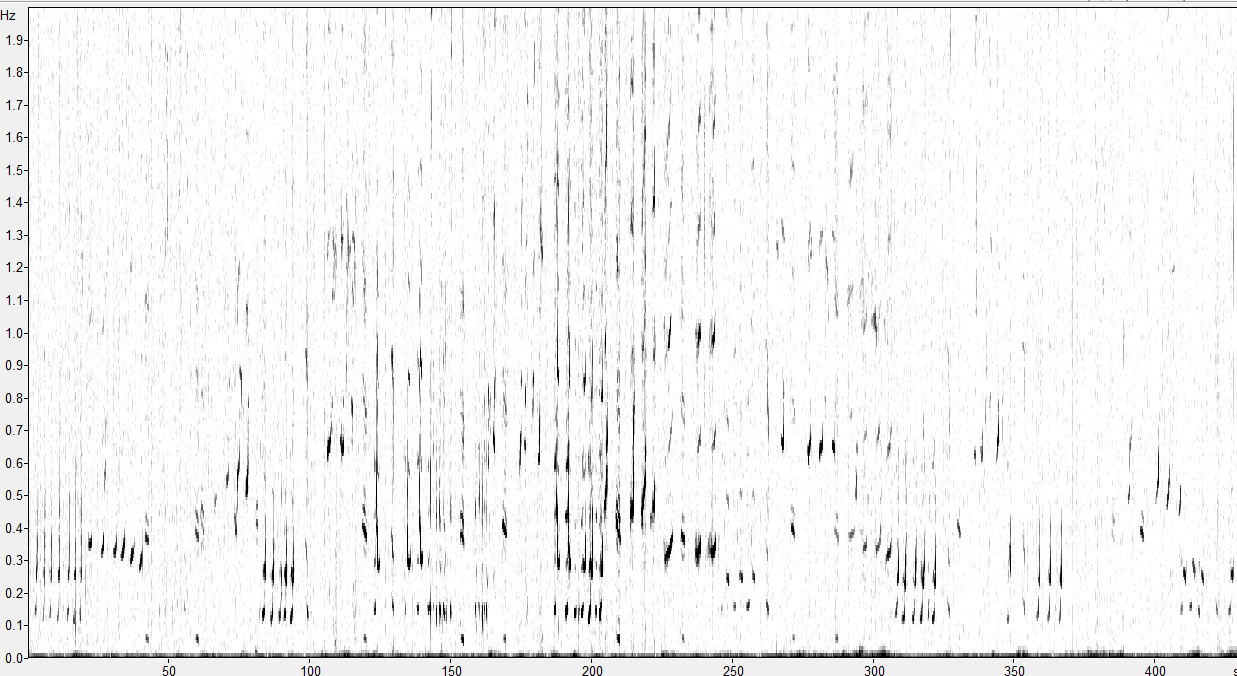 |
| Can you see the whale? Can you? |
Look at the empty spectrogram. Now at the whale one. Now back at the empty one. The empty one is not the whale one, but with patience and time, it could be.
So using programs like Ishamel, RavenPro, or SASlab, you can create these spectrograms and look for whales, fish, dolphins, whatever you need. Even things like rain, thunder, boats and jet skis show up distinctly on spectrograms. And once you know what your looking for, it's pretty easy and fast to get through the ones that don't have anything on them.
For us, once we find whale or fish or anthropogenic noise on a clip, we mark it in a spreadsheet so our supervisor can do what she needs to do.
That's it. Some people's eyes start to get really tired after a couple hours, but for some reason I can do about 8 hours worth of files without my eyes going buggy. I suppose that to be a good thing because I want to study acoustics for the rest of my life (or at least my next degree).
A really funny side effect: You start being able to look at the shape of the marks on the spectrograms and be able to make the sounds of the animal. So based solely on the whale shaped marks, I am learning to sing whale. But I will ever be as good as Dory.
That's it! It's essentially what I've been doing since I got here, other than general cleanup and maintenance of the station (AKA house).
One last thing... I love that my family and friends are reading and following this blog, believe me, the support is amazing and occasionally brings me to tears (kidding... sort of). BUT if anyone out in cyberspace is reading this and doesn't actually know who I am, I would love to hear from you in the comment section! The point is to inspire and educate, and I don't know if any of my friends or family are secretly aspiring marine biologists. That's it, just giving everyone a shout out.
Speak Loud!
Subscribe to:
Posts (Atom)