Tuesday, January 29, 2013

Zoo in Review: The Jerusalem Biblical Zoo

Hey Team!

If you would have told me that I would have used the Reviews section of this blog to talk about things other than books or documentaries... I wouldn't have believed you. Actually though, never would have thought to review places.

But today I spent the day at the Jerusalem Biblical Zoo, and man - what a zoo!!

Now, it was cold and rainy and foggy, so I only got to see about half the animals, but what a did see really blew me away!

So for the most part, the Zoo was created to breed, conserve and display animals that were mentioned in the bible (hence the Zoo's name). However, that was a few decades ago, and now the Zoo has grown into a zoo displaying species from all over the world, although still with a focus on North African, Middle Eastern and Western Asian species.

And so much conservation! It seemed like every species was critically endangered or threatened and the JBZ was working on breeding programs or rehabilitation programs with every species! It might be an exaggeration, but it seemed that way to me.

Parrots, raptors, and penguins! Turtles, crocodiles, and frogs. Lions, tigers and bears (oh my!). Asian elephants! All of them in some kind of trouble, and the JBZ is here to help (alongside a lot of other zoos. Props to them!).

Asian Elephant  - Indian sub-species

Persian Fallow Deer - once thought to be extinct!

Black-footed penguins - one of JBZ's many projects

Giant Tortoise - critically endangered


And around every corner were signs that talked about environmental conservation! There was even the "Ecological Maze", with little signs throughout it talking about ecological concerns, like pollution, and their solutions, like breeding programs! And at the end of the maze, there's a sign about "How you can help".

Cheesy, yes. For kids? Absolutely. Educational? Yes!

Man, I feel like I could go on forever! In the rainforest building, signs all over explaining all the problems facing rainforests, and others explaining why they are important. There were also signs about the importance of "primal knowledge", which is the knowledge that indigenous people have about nature. Those signs really got to me, because of my recent completion of Ishmael (keep an eye out for the book review!).

Last thing I think I really want to point out from the zoo is their "West Side Story" exhibit. Now, this is NOT a musical (I was disappointed as well), and the Hebrew title makes a lot more sense. In Hebrew, the exhibit is called "The Story of Tippy". Tippy is a water drop that falls to the Earth in the Kinneret (aka Sea of Galilee), and moves his way through the Israeli waterways, India and Australia. And everywhere he goes, he sees how people have been destroying their water systems and the implications. And every time he learns that it's people's fault, he gets more and more bad.
The "West Side Story" exhibit - the story of the aquatic concerns

Fish! That might be extinct soon if we don't help!

This story is done in cartoons throughout the exhibit, along with an explanation of the problem, and examples of species of fish that are being effected.

To me, this took the cake. I might have teared up a bit, just because I was so impressed with how much the Zoo talked about all the negative impacts Israel is having on their aquatic environments. I mean, it's their zoo, but they aren't afraid to say "Hey, we're not perfect, and what we do matters."

Basically, of you find yourself in Israel sometime in the summer, and you just happen to have a free afternoon in Jerusalem with nothing to do, hop on a 33 bus and get yourself to the Jerusalem Biblical Zoo. In a past post I talked about the pros and cons of zoos, and I said that the point of zoos (hopefully) is education and awareness. There's a lot of controversy around this statement, that they don't really work that way. But I honestly and truly believe that if there is only one zoo in the world really trying hard to make education, awareness and conservation it's focus, it's the Jerusalem Biblical Zoo.

A big indicator: They only charged me half price admission because the day was rainy and cold and a bunch of the animals weren't on display. Doesn't sound like a money-grabbing enterprise to me.

Speak Loud!

Friday, January 18, 2013

Sorry for the Silence!

Hey Team!

No, I have not given up on this blog! It's just that my last 3 months, relating to the fascinating field of marine biology, have been uneventful.

I spent 2 months back on the prairies, doing the same work on seal jaws as I did before, so nothing new there.

I am currently in Israel travelling around and seeing the country, so no marine biology here. Although I am going scuba diving this week, and that's sort of related, so maybe I'll talk about that.

but fear not! my readers (all like, what, five of you?) Starting in February I will be sitting pretty and sunny in Croatia, working on a(nother) bottlenose dolphin project! Woot! Someone would think I liked bottlenose dolphins. Which I do, but not as much as other cetaceans. It's mean having favourites, but I do.

Anyways, this means that the months of February, March and April will hopefully be more eventful. I have another book I want to review, and possibly it's sequel (when I finish), so please keep an eye out for updates more interesting than this!

Speak Loud! 

Wednesday, October 3, 2012

Book in Review: Elephants on the Edge


Hey Team!

Okay, I am a bad, bad blogger. I know this. I knew it when I started blogging. While I like to pretend I have interesting things to say occasionally, I also like to pretend I'm really busy (but if I broke down my time usage, I think a lot of it is laziness). So I haven't blogged in a bit, even though I've wanted to talk about this book for about a month now.

So welcome to a new feature of the blog: book reviews! Sometimes you read books that change your life. I have come across a lot of these types of books, but most of them don't really make the grade of this blog.

Except this one.

Elephants on the Edge: What Animals Teach Us about Humanity

Elephants on the Edge: What Animals Teach Us About Humanity is a book written by G.A. Bradshaw that takes a look into the minds and lives of elephants, and how we relate ourselves as humans to them.

That description does not do this book justice. The book looks at the history of elephants and people interactions in Africa, India and the United States. The book looks at how science has proven that elephants are sensitive, intelligent, emotional beings. The book looks at the neurological and psychological similarities ad differences between humans and elephants. The book reminds us that we have been mistreating these amazing animals for as long as they can remember (and it's true that they remember way longer than we do; it's in the book).

Elephants have always been in my top five animals list. I think my family knew it before I did. In my room, second to figurines of dolphins, I have more elephant figurines than anything else (3 wooden ones, a metal one and a white one that I am 80% sure is not ivory). And recently I have had a lot of really neat ideas swirling around my head connecting people to whales to elephants, in terms of behaviour and sociality.

So a book all about the connections between elephants and humans? I was intrigued, and after the introduction I was hooked. I read at every opportunity for 2 days and I wish I wasn't such a fast reader because I wanted to continue reading it.

I don't know how to do a book review, but I don't think it's about going chapter by chapter and explaining the book. However some highlights of the book seem right to me.

**

Back in 2000, there were reports of young bull (male) elephants attacking rhinos across South Africa. These attacks were fatal, sexual and above all, perplexing. The book tries to explain not only the reasons behind the attacks, but what we can learn about human violence and potential solutions by looking at these attacks. The book also tries to make us understand why we find the attacks to be so disturbing, even though normally interspecies (between species) violence is not something new (welcome to the predator-prey relationship).

What the book explains is that unlike humans, elephants are able to be intelligent, emotional, social animals without resorting to violence. They live in structured herds and there are never fights for dominance within herds or between them. They are a peaceful species, both to other elephants and other animals (self-defense aside). Which is why elephants attacking rhinos blew the minds of scientists and public alike. A normal reviewer might tell you what they discovered, but really, read the book.

**

Humans have not treated elephants well in a really long time. In Africa they put it back to European colonization. In the United States they put it back to the first circus elephant. In India... harder to put a date on it. But it's been a while since we've shown elephants the respect we should. Which is interesting, because study after study show that they think and feel emotional and psychological stress just as humans do. So the circus trainers who chain and isolate their elephants, the hunters who bring down a cow (female) and live-capture the calf (baby), the Mahout who beats their elephants into submission, all create victims of abuse and trauma that show the exact same symptoms that humans do. Time and time again in the book, they show examples of elephants with PTSD, depression and suicidal tendencies. Sound familiar?

And it's not subjective. Neurological tests on humans and elephants show that their brains are behaving in exactly the same way after these major life-altering traumas.

So while we as people speak out about genocides of people, call isolating children abuse and combat domestic violence against women, we turn away from the exact same abuse and genocide in a species that reacts in the exact same way. And when humans rebel against their abuse, they are freedom fighters (and more power to them). When elephants rebel (and trust me, they are smart enough to understand revenge and vengeance), we kill them and call them terrors.

I don't really see the fairness, do you? For more examples and information, read the book.

**

I think I could go on for days, and ask any of my coworkers, I did. This book made me wonder about how we treat animals in general, how many other species might be at our level (or higher) in intelligence and emotion, but we can so simply turn away. Now of course, I just finished eating chicken for lunch, so I don't know how much I have changed, but thinking about it is the first step, right?

And as a marine biologist, I easily moved Bradshaw's arguments toward my own loves, whales and dolphins. Clearly cetaceans are brilliant and feeling animals with complex social systems, but just as clearly we are able to turn a blind eye to their inappropriate use and killings. Or we see it, feel sad for a day, but then move on.

There are more movements for the freedom of people against abuse (killing included) than animals. Which I understand, we are a selfish species. And I am NOT saying these are bad. I'm just saying it's unfair, because why shouldn't animals with equal-human (I hate the term near-human. When was the last time whales started Ocean War I?) intelligence get equal human rights? The right to food, habitat, and safety? How hard are those, really?

I don't know if I did this book justice. The elephants in it are exceptional stories, as are the people who have devoted their lives to saving them. The science is sound and the scientists she cites are at the top of the field of elephant biology. There were times where I was reading stories or more often than not statistics, where I had to put the book down and walk away, because of the overwhelming sadness that came from reading it. But I could only stay away for about 2 minutes before the book pulled me back into itself. It's an addicting read.

I recommend it to every biologist, if only just to make us think about the way we ourselves use animals in the name of science. Do we have the right? And of course, I recommend it to every human soul, to make us rethink the way we treat each other, but above all, how we treat animals. Because isn't one of the early warning signs someone might be a serial killer is animal abuse?

Think about it. Read the book.

Speak Loud.

Buy the book from Amazon
Or from Chapters

Because I am not kidding.

Friday, September 14, 2012

Back from Camp!

Hey Team!

Wow... it's been a really long time. I can't believe I didn't blog for the entire month of August! Cetus has been going through some tough times. We get the majority of our funding from the federal government, and we were supposed to hear about approval back in March. Well we are in to September and we still haven't heard anything. So from mid-July onward we have been off the water. My supervisors have been trying to keep us all busy, but until very recently it's just been a lot of filler work.

It worked out that in the meantime, I got to go up North, off Vancouver Island to work with the Robson Bight Marine Ecological Reserve Warden Program. Whoo, that's a mouthful!

So The Robson Bight Ecological Reserve is a bit of water that is closed to all boat traffic, except for commercial fishing ships during fishery openings. So the job of the warden program is to watch the waters of the Reserve and make sure that no boats go in. Especially with whales around. And with straitwatch off the water, they've also been doing a bit of vessel monitoring, but they don't take any data on that.

Anyways, I got to go up for two weeks and be an intern for the wardens. The base camp really is that... a camp. We sleep in personal tents, cook off of camp stoves and spend our evenings around the fire. There is no electricity except to recharge small electronics, no running water and no roads. The only way to get to boat bay is to well... take a boat!

Can you say remote?

There were two parts to the job: the cliff and the boat. After a tiring 45-50 minute hike through a temperate rain forest you get to the top of a very high cliff directly across from the Bight. Once there, you take a boat count every 15 minutes, detailing how many of each kind of boat you see, where they are (in terms of determined zones) and how fast they are going (stopped, fast, slow). Also every 15 minutes you are doing an orca scan. These include how many, where they are and if you can, which ones they are. We pretty much left the orca scans to our boss, FM. On top of the scans, every time a boat crosses in front of the cliff you have to record it: time, type and direction.


If that didn't seem like enough work, local ecokayaking tours will also hike up the cliff (from a different direction) for an interpretive talk, where we tell them all about the Bight, the whales and Cetus. These are a lot of fun because the people on the tours are generally really enviro-friendly and curious. And they usually buy a hat or CD (thank you for the support!).

On the boat, the main thing is to keep boats out of the reserve. We hang around camp until we get "the call", then we get to the boat and on the water. I always felt like a firefighter on boat days. Always half ready, not getting into anything that I couldn't put down at the drop of a hat. Once on the water we zoom off to the (usually ignorant) perpetrator and kindly inform them that they are in a no-boat zone. Occasionally we'd have the chance for further interpretation and tell them more about the reserve and the whales.

We'd also go out if there were whales, though the priority was if there were both boats and whales in the areas around the Bight. From an exceptionally safe distance we would keep an eye on whales, only really moving to keep them in sight or if a boat was approaching.

In the weeks I was there whales occasionally took the day off, so some of my boat days were short and sporadic on the water. But it felt so good being back on the boat and seeing killer whales again. It's amazing how much you can miss bouncing around on the waves.

One of the funniest moments on the water was when we were swarmed by Pacific white-sided dolphins. We were chasing down a boat and then off a sudden we had between 6-10 dolphins riding our wake (the waves made by the motor) and our bow (the rushing water going by the front of the boat). Most people think this is awesome, because the dolphins come so close you could touch them. Us? We were annoyed because they were in our way and we were way too close to marine mammals! We spent a good 5 minutes telling them to go away!

That being said, it was cool being close to dolphins again, I haven't been since Florida. And how many people can say they were splashed by a wild Pacific white-sided dolphin? I can!


All in all, it was an amazing two weeks. The other people I worked with were a lot of fun and we were able to have great in dept discussions about everything environmental, political and human-related with ease, acceptance and open-mindedness. Thank you Cetus for running such an amazing program and for letting me be a part of it!


Speak Loud!

Monday, July 16, 2012

Killer Factoids


Hey Everyone!

So I realize now that while most people will know what a killer whale is, how many know what they are all about? Well, I think a new "feature" in this blog will be a quick fact sheet on the feature species of an internship. Starting with my second favourite cetacean species, the orca, aka the killer whale.

So. Twenty-five facts on the killer whale.

**


1. Killer whales aren't technically whales at all. They are the largest dolphin species in the world.

2. "Orca" means "demon of the underworld". So whether you call them orcas or killer whales, it doesn't really matter. They're pretty hardcore no matter what you call them.

3. An orca's life span is normally between forty and fifty years old. That being said, there is a whale in B.C. that they think is over 100 years old.

4. Killer whales are found around the world. The North Pacific, the North Atlantic, the Antarctic Ocean, and a couple seas as well.

5. Every population has sub divided into two or three "ecotypes" - fish eaters and mammal eaters. They can also be differentiated by colour patterns, eye patch size, foraging/ family behaviours and acoustics.

6. These ecotypes never interact with each other. They avoid each other physically and don't breed with each other.

7. Off the coast of British Columbia there are three ecotypes: The residents (fish eaters), transients (marine mammal eaters) and offshore (fish/shark eaters).

8. The resident orcas feed primarily on chinook salmon. A study that looked at the stomach contents of residents found that over 90% of their diet was chinook. 

9. Transients feed on more of a variety, but only marine mammals. Dolphins, porpoises, sea lions, seals, small(-er) whales. They will not each fish. The Vancouver aquarium's first rescued whale didn't eat for almost a month because they kept trying to feed it fish. They say once you taste red blood you never go back. They're like vampires.

10. We don't know a lot about offshore, but they have found that their teeth are so worn down that we believe they are eating sharks and the skin is grinding down the teeth.

11. Residents live in large pods, between 20-50 individuals. They have matriarchal society, which means each pod has a primary female matriarch. Her offspring stay with her their entire lives, unless a daughter has enough offspring of her own to start their own pods

12. Residents hunt primarily through echolocation, because fish are pretty stupid. They work as a team to take out as many fish at a time as possible.

13. Transients live in much smaller pods, a maximum of 10 individuals. Their society is a lot more fluid, but they also tend to stick close to family.

14. Transients are hunting much smarter animals, and animals that can hear echolocation. So they have to be super sleuth about hunting. They are pretty quiet, working either alone or with only a couple others to bring down their prey.

15. Killer whales share their food. Not just mother/offspring, but any individuals around after a kill will get a piece. And this is transients and residents. There are videos of these massive animals gracefully tearing off small pieces of salmon in order for everyone to have a taste.

16. Chinook salmon are the largest species of salmon on the west coast, which means that not only do killer whales like to eat them, so do humans. This has but a lot of pressure on the killer whales.

17. In the 60s/70s, People decided that killer whales were a pest and a hindrance to the commercial fishing, so the government implemented intense killer whale whaling. A machine gun was set up for the sole purpose of killing orcas. Fortunately, it was never fired.

18. But during the time of whaling and these decisions, the populations took a massive dive. Now, there are about 200 transients, just under 200 Northern residents and only 87 Southern resident killer whales.

19. We don't know yet if the Southern population will ever recover, because they are facing three massive issues: Lack of food, boating traffic and pollution and contaminants.

20. As skillful a hunter as killer whales are (and trust me, they have mad skills), they can't compete with humans. And when they share each kill, and each kill becomes harder and harder to make, the whales really are slowly starting to starve off. British Columbia has some of the most sustainable fisheries in the country, but it might still not be enough. Add on top all the sport and recreational fishers, who are also looking to catch a big ol' chinook, and we have a problem. (If you are buying salmon, ask first if it is wild harvest vs. farmed, and try to avoid B.C. chinook salmon).

21. Orcas are big and can go pretty fast, but boats are faster. If someone is just speeding through a pod of orcas, they might be able to move out of the way fast enough, and those propellers are sharp. Plenty of whales found and assumed dead have been from prop accidents, because usually in nature vs. machine, machine wins. (Go slow in areas known to have killer whales in them)

22. The residents rely on echolocation to find their scarce food source, and boats are extra loud in the water. The sound of motors cover their communications, making it harder, if not impossible, for a pod to hunt. And they are hungry (Don't get close to whales with your motor running. If you find yourself close to whales, shut down to keep quiet).

23. Having to come up for air is hard! Having lots of obstacles in your way makes it even harder! Any kind of water vessel makes it more stressful for killer whales to travel, hunt and breathe, and they can't afford to lose energy stressing out. (Don't get close to whales, and stay out of their path of movement).

24. Southern resident orcas are the most toxic animals in the world. They have accumulated massive amount of toxins in their bodies from pollutants and chemicals found in our waste. Chemicals used as fire retardants, pesticides, herbicides, you name it. (Know what goes into your products!)

25. Entanglements in fishing gear and deaths cause by physical pollution is nothing new to killer whales. Scientists have found tons of garbage in the stomachs of beached whales. (Reduce, reuse and recycle! Replace plastic in your life as much as possible).

Depressed? Don't be! These are amazing creatures and people have dedicated their lives to learn as much as we can about them and through education, learn what we can do to save them!


Speak Loud!

Friday, July 6, 2012

Watching Whale Watchers

Happy One Year Anniversary everyone!!

Yes, one year ago today, I thought it would be a good idea to share my experiences and knowledge of marine biology with the world. As far as blogs so, it's not going to win any awards, but I think it's come in handy from time to time.

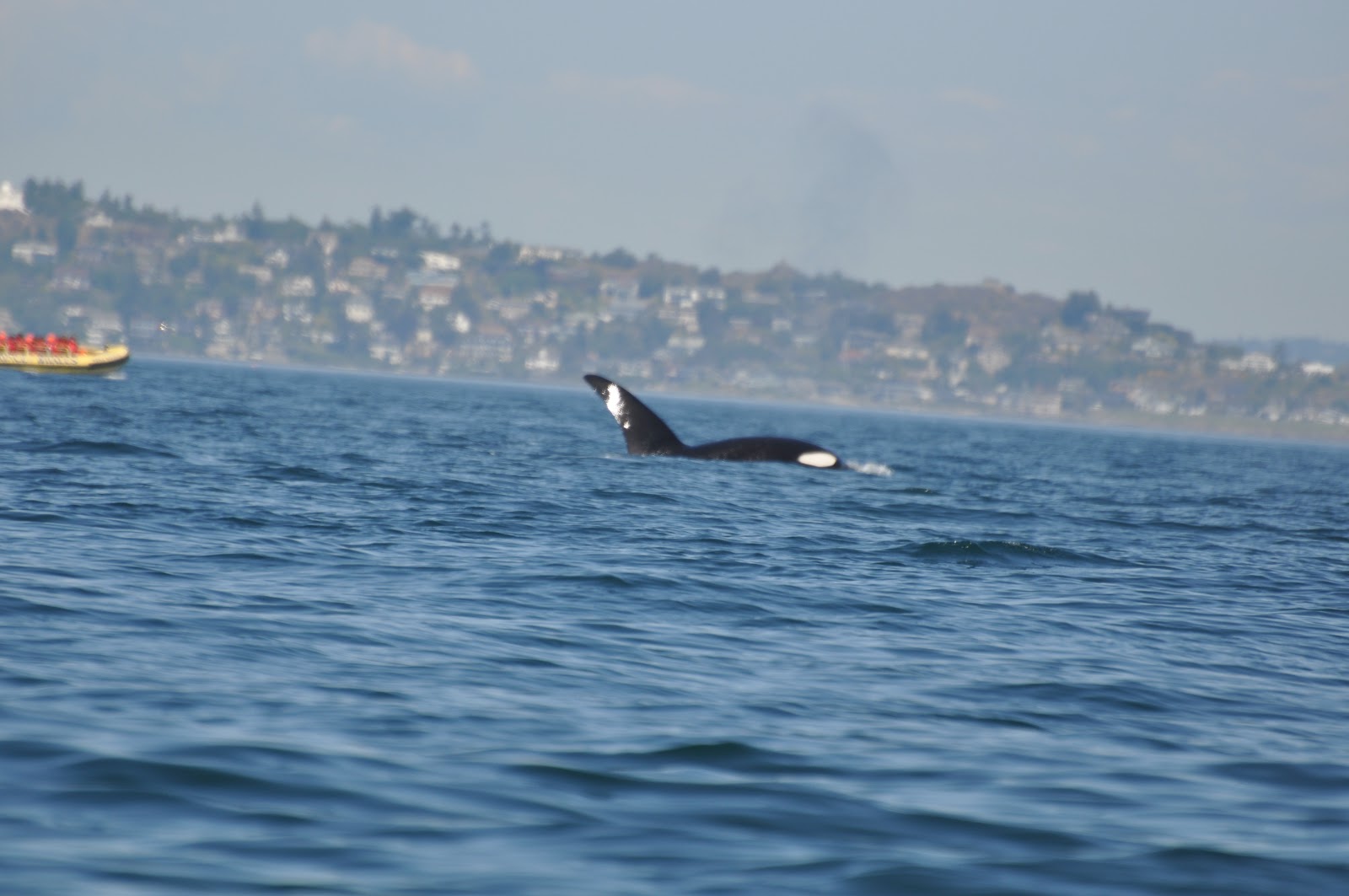
So to celebrate the occasion, I figured I would talk about the biggest part of what I came out to Victoria to do: watch killer whales!

There are three major problems facing killer whales off the B.C. coast: lack of food, pollutants and toxins in the water and boat traffic and disruption. The DFO is doing it's best to balance salmon for people and for whales, and we can all do our part by being aware of the chemicals in our products (like PCPs, DBTs, etc.) and by limiting our waste (excess packaging is the enemy!). But one thing that is hard to deal with is boat traffic.

That's where the straitwatch program comes in.

Killer whales are amazing animals. They are huge, intelligent, majestic animals and seeing them really does make your heart sing. We don't want to take that away from people, so we aren't there to harass people on whale watching tours, because people who 'interact' with animals are more likely to want to help them (see my post on zoos and aquariums here).

But having a lot of boats around the whales is a problem, for three big reasons: motors are loud and disrupt their echolocation and communication, boat propellers do an excellent job of cutting up and potentially killing animals when they collide, and boats are obstacles for travelling and breathing. Imagine you are swimming in a pool, and you need to come up for air. If there are people, noodles, toys or boards all around, finding a place to come up for a breath is more difficult, and it puts physical stress on your body. That's what happens to whales when there are ten, twenty, forty boats around. And these guys aren't eating enough to have any more stress put on them.

So the Canadian government has put guidelines in place for safe whale watching. You can't go closer than 100m, you stay out of their path of movement, front and behind, and you have to slow down within 400m of the whales, to limit motor noise and to avoid accidentally hitting one. Failure to follow these guidelines can be considered marine mammal harassment and that is illegal.

Fairly simple, yes? We think so, but they only work if people know them.

So we go out every day in the summer and are on the water basically to educate. We take half-hourly vessel counts around a focal group of whales, as well as perform incidents scans, where we watch for anyone being non-compliant with the guidelines. In between all this data collection, we're talking to private boaters and making sure they know the rules. Ignorance is the environments biggest enemy.

Most of the people we talk to seem to be unaware of the guidelines, although we take every answer with a grain of salt. Some are really interested in the whales and we'll tell them some of the biology surrounding them (I think I'll do a Killer Whale Facts blog soon...) again, to get them interested in the animals and hopefully in their conservation. Some people aren't so friendly though, and really do see the whales as a pest rather than something to protect. We can't change everyone, but we can do our best.

Beyond killer whales, we see some other really cool animals. Harbour seals, harbour porpoises, and the coolest so far, a minke whale! The waters of British Colombia are full of amazing animals, and it's so important for us to try to make a difference.

One of my favourite stories is one of a young boy walking on a beach, filled with starfish that had been washed up on the shore. Hundreds and hundreds of starfish out dying in the hot sun. In the distance, the young boy sees an old man slowly bending down, picking up a single starfish and throwing it back into the sea. The boy watches the man do it again and again, slowly and surely. The young boy walks up to the old man and says "Sir, there are hundreds and hundreds of starfish on the beach. You are going so slowly, you will never be able to save them all." The old man smiled to the boy and said, "You are right, I can't save them all. But I have saved this one, and that will have to  be enough."

Maybe the positive impact straitwatch is making may seem like a small one, but any sized step towards environmental reconstruction is a step in the right direction, and one I am more than happy to make 4 days a week. Even in the rain. And wind. And waves.

Speak Loud!

PS. Have a piece of cake to celebrate this blogs anniversary! I promise I won't tell!

Thursday, June 28, 2012

The Politics of Science

Hey Team!

First I am sorry that once again, this blog is being very sporadic. I know that the makings of a good blog is consistency, but if you haven't learned this by now with this blog, my life in anything but consistent! And as this is all about things I learn as I learn them, there are times that I am not learning much.

Second, this is going to be a very Canada-centred blog post, but if you reading this from another country (hello from Canada!), I hope that it can somehow be relevant to you as well. If not, you might just be lucky (or possibly extra unlucky).

**

Canada seems to be going through a very interesting bout of politics at the moment. Almost as interesting to us as the US politics, which is a big deal. We had a lot of fun about a year ago, when we had to have a re-election and the same party that held a minority government got voted in again, but with a majority government.

Which to most people would make you think that Canada wanted them in power, yes? I mean, we a democratic country and we vote in the people we want in government. Personally, I think we have it pretty sweet, considering the alternatives.

But of course, not everyone is happy with our current government. And I don't expect them to be. Democracies function out of a collective of ideas, not singular ideologies.

I'm rambling again, let's re-focus this post...

The Conservative Party, the current Canadian government, has a certain way of running the country. It has kept us out of deep economic turmoil and has some pretty strong opinions on our foreign front. But where it is sorely lacking is in its support of scientific (mostly biological and environmental) research and funding.

The collective "we" of the science community have had some serious issues with government policies over the last few months. Budget cuts have meant cutting entire labs that are looking into some really important labs, prominent scientists are now job hunting and practices that we know are detrimental to the environment (see oil, fishing) are still going with no signs of slowing down.

And, like I've said in the past (over and over again), there is no money anywhere. But sometimes it's difficult to watch government money go to other programs when we are struggling to make ends meet.

Now, I'm not a politician. I don't understand politics. I am the last person to get on a soapbox and say I can do it better than the people in Parliament. And I know that there is so much more to running a country than being concerned about the environment (which is why I never vote for the Green Party). And I also don't believe that either of the other two major parties in Canada would actually do a better job if they were in power. It's really easy to promise the voters change when you have no control over anything (like how I think it should be really easy to change over all electricity to solar power).

Scientists are passionate people. If we weren't, we'd be pretty bad at our jobs. Which means that most scientists have really strong opinions on how the country is run, and we tend to focus on things most important to us, like the environment, the animals and of course, the financial support to do the research that we believe will save the world (which I do actually believe we are doing).

But when you have more than one interest in political parties, it can get difficult. I don't agree with a lot of the choices the Conservatives are making environmentally. I don't think letting go of DFO researchers, shutting down labs and opening new fisheries are smart ideas. I would love for them to stop funnelling money into the Alberta oil companies and start financing solar power research (can you tell I'm super into solar power?).

But, I like that I can still find some kind of job when I really need one. I like that this government seems to be doing its best stand strong against international madness and is actually speaking out against racism here in our own backyard. I like that they aren't trying to create and fund more social programs that we can't afford, because I really don't want to pay more taxes on everything I buy.

So sometimes I feel really stuck. I love the fact that people are passionate about the politics of the country, because we should demand the best of our government. But how do you balance their passionate displeasure with your more neutral approach? Sometimes it's hard to smile and nod and agree with their vehement dislike of the government, because while I agree with the issue at hand, I have a lot more than just environmental interest in our government.

I'm not sure if there is a lesson here, or if this was just a ramble. I definitely believe that you should question whoever is in power, and if they do something you don't like, you should say something. We have the privilege of living in a country that lets us do that. And we won't be able to make the most forceful impact on our environment without governmental support, and I really wish we had more from our current government. But at the same time, we have to remember that there is a lot that goes into running a country, more than just what is good for the environment.

Leave an opinion, I am really curious to hear what people think. Please feel free to agree or disagree, just be nice about it!

Speak Loud!