Hey Guys!!
Sorry it's been SUCH a long time since I last undated this thing. While working in Puerto Rico I broke my laptop (there were serious tears) so I didn't have all my excellent resources to help me write this!
But now I have it back, I'm back home on the range (AKA The Prairies) and I am in a new position at an old job that I can't wait to tell you all about!
So no, I'm not dead and yes, I am still writing. If by magic my computer still has some notes I took I might have one or two more posts about Puerto Rico, but I am excited to share my work back at the DFO!
Speak Loud!
Wednesday, February 22, 2012

Monday, January 23, 2012
Meet My Friend, Theo
While we all sit around finagling (I can't believe that it's a real word, but it is) with a silly program (more on it later in this post), I figured I'd write my next blog post. Another educational one, on a piece of equipment lovingly called a theodolite.
Never heard of it before? Neither had I until I started applying for internships in marine mammology. Seemingly it was originally used for surveying on land, but someone thought "why can't I track dolphins using it?"
Well... you can, I guess; but it's really really hard.
Too late, it's the thing to do now. Le sigh.
First. Climb up to the top of a high cliff. Make sure you have a clear sight to the water, no trees or tall buildings in the way.
So now you have this theodolite
 |
| Hello, Theodolite |

 |
| Hello, Stand |

Set it up. Make sure it's level. Otherwise steps after this will be harder. Use little bubble levels to make sure it's level.
Using two hands, place the theodolite on the stand. Screw it in. So far, so good.
Now... level the theodolite. There are three levels on the theodolite.
You use the little discs to mirco-move the theodolite up and down until the theodolite (for now on being called 'theo') is completely level no matter which way you spin it. Note: there are two dials on the theo. One lets it spin on the horizontal plane, the other let's the eyepiece spin on the vertical plane.
Okay, turn it on. Spin the eyepiece around until the theo recognizes it (beep!). Then you need to set the horizontal 0 mark. You can use any reference point, but then you have to remember your reference point for the day and it'll change every time. So why not just use North? That way, you can use the same reference every single time! Genius! I wish I had come up with it.
Press the "0 set" button and you're ready to go.
Find something to track. Boat, jetski, surfer, dolphin, whale, whatever. Line them up above or below the white arrows which are set up like a sight of a gun (I had to be told that). Then look through the eyepiece and you'll see a cross hair (now I feel like a stalker/ sniper). The goal is to line up that crosshair at the exact same place on your subject every time.
Now the theo is part binocular, so you can see things in the water from so far away. So as your subject is moving, you can fine tune the eyepiece to follow it as it moves through the water.
It's hard. Like, really hard. Like, ridiculously really hard.
While watching your subject, when it does something of interest, you record the behaviour and the 'location' that is on the theodolite. Then you can use that 'location' to figure out a true location later on (which will come in another post).
That's all there is to a theodolite. In essence, it's an easy piece of equipment to work. In reality, it's a pain that takes years and years of experience to expert. But it's effective and less expensive than tagging whales.
Speak Loud!
Saturday, January 21, 2012
Look at What You're Listening To
Phew! I moment to breathe! And therefore, a moment to blog.
It's been a non-stop whirlwind for the past 11 days. The station is set up, we are trying to find people with boats willing to take us out to look for whales, and in the background, a couple interns are busily trying to find whales in the midst of hundreds of thousands of sound clips.
Yupp, I said hundreds of thousands.
So young padawans, I am going to (try to) explain to you the intricacies of acoustic analysis.
Hydrophones are underwater microphones attached to recorders that are suspended in the ocean by buoys. They record noise at intervals for a specific amount of time, then are brought back to the surface. The recorded clips are downloaded onto a computer, and then analyzed by people with absolutely no time on their hands (which is why they ply interns with free accommodations and a tropical setting).
The clips, in some kind of sound file format, can be analyzed in a variety of ways. One way would be to simply listen to them. All of them. Now can anyone tell me the problem with this?
Let's do a math question: a hydrophone records for a 20 second interval every five minutes for 5-8 months. What would be the length of sound you would have to listen in order to analyze every file created?
I don't even want to do the math. Bonus points for whoever does (and comments below).
So obviously that is a bigger waste of everyone's time than watching grass grow or paint dry. Plus everyone's range of hearing is different, so who knows what one person might miss?
The solution to this is to look at the sound files and find whales.
Wait... what? What dimension are you living in? Seeing sound files?
Calm down! Let me explain...
Spectrograms are a type of image that let's you see sounds over their frequency range over an amout of time. It's a graph, x by y, but each point is so minute and there are so many that it becomes an image. An image of an empty underwater spectrogram might look like this...
If it looks like a lot of mess, that's because it is. The ocean makes tons of noise, and that's all it is: noise.
Look at the empty spectrogram. Now at the whale one. Now back at the empty one. The empty one is not the whale one, but with patience and time, it could be.
So using programs like Ishamel, RavenPro, or SASlab, you can create these spectrograms and look for whales, fish, dolphins, whatever you need. Even things like rain, thunder, boats and jet skis show up distinctly on spectrograms. And once you know what your looking for, it's pretty easy and fast to get through the ones that don't have anything on them.
For us, once we find whale or fish or anthropogenic noise on a clip, we mark it in a spreadsheet so our supervisor can do what she needs to do.
That's it. Some people's eyes start to get really tired after a couple hours, but for some reason I can do about 8 hours worth of files without my eyes going buggy. I suppose that to be a good thing because I want to study acoustics for the rest of my life (or at least my next degree).
A really funny side effect: You start being able to look at the shape of the marks on the spectrograms and be able to make the sounds of the animal. So based solely on the whale shaped marks, I am learning to sing whale. But I will ever be as good as Dory.
That's it! It's essentially what I've been doing since I got here, other than general cleanup and maintenance of the station (AKA house).
One last thing... I love that my family and friends are reading and following this blog, believe me, the support is amazing and occasionally brings me to tears (kidding... sort of). BUT if anyone out in cyberspace is reading this and doesn't actually know who I am, I would love to hear from you in the comment section! The point is to inspire and educate, and I don't know if any of my friends or family are secretly aspiring marine biologists. That's it, just giving everyone a shout out.
Speak Loud!
It's been a non-stop whirlwind for the past 11 days. The station is set up, we are trying to find people with boats willing to take us out to look for whales, and in the background, a couple interns are busily trying to find whales in the midst of hundreds of thousands of sound clips.
Yupp, I said hundreds of thousands.
So young padawans, I am going to (try to) explain to you the intricacies of acoustic analysis.
Hydrophones are underwater microphones attached to recorders that are suspended in the ocean by buoys. They record noise at intervals for a specific amount of time, then are brought back to the surface. The recorded clips are downloaded onto a computer, and then analyzed by people with absolutely no time on their hands (which is why they ply interns with free accommodations and a tropical setting).
The clips, in some kind of sound file format, can be analyzed in a variety of ways. One way would be to simply listen to them. All of them. Now can anyone tell me the problem with this?
Let's do a math question: a hydrophone records for a 20 second interval every five minutes for 5-8 months. What would be the length of sound you would have to listen in order to analyze every file created?
I don't even want to do the math. Bonus points for whoever does (and comments below).
So obviously that is a bigger waste of everyone's time than watching grass grow or paint dry. Plus everyone's range of hearing is different, so who knows what one person might miss?
The solution to this is to look at the sound files and find whales.
Wait... what? What dimension are you living in? Seeing sound files?
Calm down! Let me explain...
Spectrograms are a type of image that let's you see sounds over their frequency range over an amout of time. It's a graph, x by y, but each point is so minute and there are so many that it becomes an image. An image of an empty underwater spectrogram might look like this...
 |
| Sample found here |

BUT
When something biological makes sound, it shows up crisp and clear against all the background noise. Here is an example of a humpback whale spectrogram.
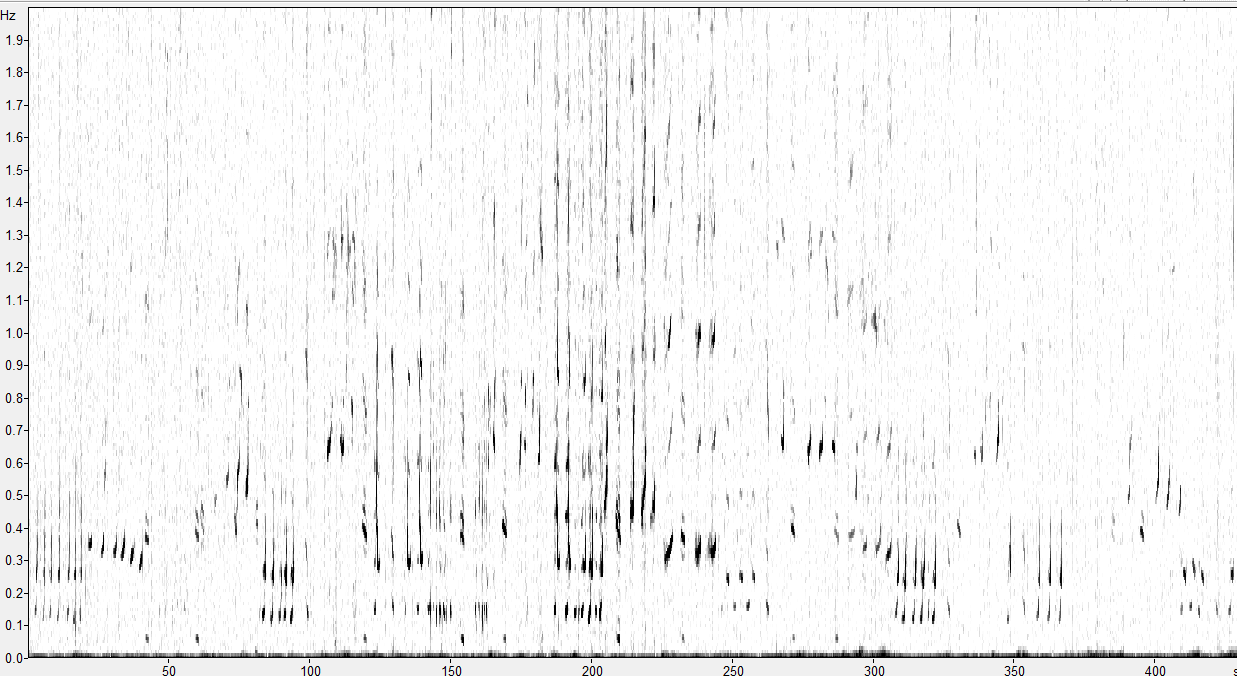 |
| Can you see the whale? Can you? |
Look at the empty spectrogram. Now at the whale one. Now back at the empty one. The empty one is not the whale one, but with patience and time, it could be.
So using programs like Ishamel, RavenPro, or SASlab, you can create these spectrograms and look for whales, fish, dolphins, whatever you need. Even things like rain, thunder, boats and jet skis show up distinctly on spectrograms. And once you know what your looking for, it's pretty easy and fast to get through the ones that don't have anything on them.
For us, once we find whale or fish or anthropogenic noise on a clip, we mark it in a spreadsheet so our supervisor can do what she needs to do.
That's it. Some people's eyes start to get really tired after a couple hours, but for some reason I can do about 8 hours worth of files without my eyes going buggy. I suppose that to be a good thing because I want to study acoustics for the rest of my life (or at least my next degree).
A really funny side effect: You start being able to look at the shape of the marks on the spectrograms and be able to make the sounds of the animal. So based solely on the whale shaped marks, I am learning to sing whale. But I will ever be as good as Dory.
That's it! It's essentially what I've been doing since I got here, other than general cleanup and maintenance of the station (AKA house).
One last thing... I love that my family and friends are reading and following this blog, believe me, the support is amazing and occasionally brings me to tears (kidding... sort of). BUT if anyone out in cyberspace is reading this and doesn't actually know who I am, I would love to hear from you in the comment section! The point is to inspire and educate, and I don't know if any of my friends or family are secretly aspiring marine biologists. That's it, just giving everyone a shout out.
Speak Loud!
Thursday, January 12, 2012
On a Scale of Yellow to Purple...
So I just seem to keep getting more and more South! As I've said to friends and family back home, I am not looking forward to Northern weather after spending 5 months in the tropics (add the three months of summer at home before that, and I have spent 8 months in shorts and tshirt weather)!
For those of you know don't know, I am now sitting in Guayanilla, Puerto Rico at the Marine and Coastal Ecology Research Centre, where I am going to be analyzing humpback whale acoustics for approximately 3 weeks. Tres exciting, no? Oui! Okay, enough French.
More details on the actual science once I do some more of it, and when I have a better idea of what we're doing. This post is more to turn on the alarm for another one of my little wake-up calls to aspiring Marine Biologists; and that is the whole point of this blog anyways (that, and so I can stop trying to explain what I do to my parents).
This post, my dear friends (and random readers... I know you're there, leave a comment!), is too discuss my present living and working arrangements. Which is a far, far cry from my situation back in Sarasota.
Disclaimer: This is NOT me complaining at all. This is an experience that I am more than excited to have and I think it'll make me a better scientist in the future. This is simply comparing one research site to another, and a way to look at the variation of arrangements you have to be prepared for in this field.
Okay, so...
In Florida, I lived in an apartment that was about a 15 minute bike ride from the lab. Yes, I had to share it with 3 other girls and yes, I did have to share my room. It had a living room, a kitchen 2 bedrooms, 2 bathrooms and a little porch.
In Puerto Rico, 8 of us are in a 3 bedroom house. 2 of the rooms have bunk beds, where 4 people sleep, the master bedroom is for our supervisor and her significant other, and 2 of us (including yours truly) are sleeping in what could be considered the living room area on a couple of cots. Our kitchen does not have a stove, so we cook everything either on the propane BBQ, in the toaster oven (we've baked bread in it, guys) or in the microwave. You can't put anything in the toilet or it will clog the septic tank. This includes toilet paper. Used toilet paper goes into a little waste basket that gets cleaned out every night. There is no hot water anywhere. Kitchen sink, bathroom sink, washing machine, shower: all cold water. The internet is pretty weak, especially with 8 people on it at the same time. So no skyping, and no online TV shows or movies. And the house is also the "lab", where we all sit on our computers and do the analysis, and where all the field gear is stored.
In Florida, the lab was in the corner of the Marine Mammal Research Centre. It had half a dozen offices, an AV room, a storage room or two, a little kitchenette and a conference room.
In Puerto Rico, we sit outside at a dining room table with our laptops and do everything off of programs we've installed or downloaded. Our gear is stored in the front porch (which has to be kept locked at all times), or anywhere else we can find room for it.
In Florida, we had pretty set office hours. Sure, when we were in the field you had no idea what time you'd be home for dinner, but on lab days we came in at a certain time and for the most part left at a certain time.
In Puerto Rico, we are supposed to start work at a certain time (and we're pretty sure we'll be able to do it), and we're supposed to only work to a certain hour, but seeing as we're all around in the evenings anyways, it's easy to try to wrangle some work out of us at night as well, even if it's just easy work.
In Florida, we were assisting in a study that had been in progress for over 40 years. The science behind it was near perfect, the methods near flawless, and our supervisors knew the in's and out's of all the programs we used for our photo-ID and any other analysis done.
In Puerto Rico, this study is less than 5 years old, and the acoustic analysis is a brand new addition. So our supervisor is learning right along with us, and we are being little guinea pigs for programs and analysis methods.
There are probably a million other differences between the studies, but those are some of the biggest. We all cook and clean communally, something we didn't really do in Florida, and the team is a lot more diverse than back at Mote. These are the realities of the job. You're not always going to be working in a well situated institute. Sometimes you are going to be working somewhere without running water or something like that. So consider all the differences I've posted. If you don't think you can handle it, I might suggest reevaluating the specifics of your career choice.
The title for this post was meant that even though it is a comparison along a scale, one is not necessarily better than the other (like a scale of 1 to 10, or white to black, etc.). Both types of field/living sites are exciting and offer pros and cons, just like yellow and purple. Plus I like both those colours :)
On a completely other note, those who know me more personally know that I spent about 11 days travelling around Puerto Rico before settling into the internship. For those who don't know me personally, you know that now. I survived it, I met some amazing people, and learned a bit about travelling around Caribbean islands. This is not the forum to talk about my travels, but I'm sure if I talk to you soon, you'll hear all about it!
Speak Loud!
Saturday, December 3, 2011
Holding Out for a Hero
... Or at least a blue whale.
Day Five - Friday
Feeling of the day: Determined.
It was a pretty laid-back day. After the wild night of Manatee Mayhem, no one really wanted (or were able) to concentrate on lots of talks in the morning. So I went to a few, just the ones I thought I'd really get something out of, but spent a lot of the day sleeping and exploring downtown Tampa.
The reason the feeling of the day was determined was that I found myself with a really strong grasp on what I want my Masters to look like. And I think that while it's problematic to close yourself in too much, because then you lose out on opportunities, it's important to know your limits and what is going to make you happy. An opportunity is torture when you are miserable.
So I started working through a lot of that during the week, but today it was finalized in my mind.
I don't want to go to school in the United States. I don't like the way their graduate school system works, it's ridiculously expensive and quite frankly, I really prefer Canada as a country and as a people. I've been asked if that means I wouldn't consider going farther abroad for school, but I think I'd be okay in another British-style country. Which works out for me, because that's where a lot of blue whale research goes on (for example: Australia. Or the UK).
Another thing I determined is the type of "perscientist" I want to be. Yes, I just made up the word 'perscientist'. It is a combination of 'person' and 'scientist', because with some people, they way they are professionally is different than the way they are personally, and that just doesn't sit right with me. Unfortunately, I am trying to throw myself into an exceptionally competitive field. So when it comes to other people in the same state of affairs as myself, it's natural to want to don fangs and claws and beat them at everything.
And I have met them all here. The people who are amazingly supportive of my dreams and offer lots of advice and names and business cards. And the ones that give you the once over when you express similar goals to theirs. It's part of the game, but you have to figure out what kind of 'perscientist' you want to be, because it's not enough to just be nice to those farther down the line. The best way to know someone's character is how they treat their direct competition.
Another thing (sorry this post has no flow!) is that over this week I got a lot of advice. Which is great, but can seem overwhelming as you try to sift through it all. That's why it's important to have a really clear idea of what will make you the most happy. Because it's really easy to feel like you have to take everyone's advice, because they've been around the field longer and do probably know better. But they don't know you better. So while one person was telling me all about places to try and get research spots pertaining to killer whales, I smiled and nodded and wrote them down, but in the back of my mind I was thinking 'I don't want to invest too much time into looking into all this until I know that my blue whale research will fall through.' And if there's is the smallest chance that I can start fulfilling dreams, I am going to take them, even if it's a little bit more work.
So advice: know your limits, be nice to the competition (one day they won't be competition anymore), be nice to those struggling beneath you (you were once them) and don't feel like you need to take everyone's advice all the time, because they don't know you as well as you do.
Wow. A whole five days of blogging. How do people do this on a regular basis? I should be going back to my sporadic updates now that I am back home in Sarasota and that the internship is winding down.
But something for all you readers to look forward to... 27 days until I land in Puerto Rico, then 12 days later I start my next internship!
Speak Loud!
Day Five - Friday
Feeling of the day: Determined.
It was a pretty laid-back day. After the wild night of Manatee Mayhem, no one really wanted (or were able) to concentrate on lots of talks in the morning. So I went to a few, just the ones I thought I'd really get something out of, but spent a lot of the day sleeping and exploring downtown Tampa.
The reason the feeling of the day was determined was that I found myself with a really strong grasp on what I want my Masters to look like. And I think that while it's problematic to close yourself in too much, because then you lose out on opportunities, it's important to know your limits and what is going to make you happy. An opportunity is torture when you are miserable.
So I started working through a lot of that during the week, but today it was finalized in my mind.
I don't want to go to school in the United States. I don't like the way their graduate school system works, it's ridiculously expensive and quite frankly, I really prefer Canada as a country and as a people. I've been asked if that means I wouldn't consider going farther abroad for school, but I think I'd be okay in another British-style country. Which works out for me, because that's where a lot of blue whale research goes on (for example: Australia. Or the UK).
Another thing I determined is the type of "perscientist" I want to be. Yes, I just made up the word 'perscientist'. It is a combination of 'person' and 'scientist', because with some people, they way they are professionally is different than the way they are personally, and that just doesn't sit right with me. Unfortunately, I am trying to throw myself into an exceptionally competitive field. So when it comes to other people in the same state of affairs as myself, it's natural to want to don fangs and claws and beat them at everything.
And I have met them all here. The people who are amazingly supportive of my dreams and offer lots of advice and names and business cards. And the ones that give you the once over when you express similar goals to theirs. It's part of the game, but you have to figure out what kind of 'perscientist' you want to be, because it's not enough to just be nice to those farther down the line. The best way to know someone's character is how they treat their direct competition.
Another thing (sorry this post has no flow!) is that over this week I got a lot of advice. Which is great, but can seem overwhelming as you try to sift through it all. That's why it's important to have a really clear idea of what will make you the most happy. Because it's really easy to feel like you have to take everyone's advice, because they've been around the field longer and do probably know better. But they don't know you better. So while one person was telling me all about places to try and get research spots pertaining to killer whales, I smiled and nodded and wrote them down, but in the back of my mind I was thinking 'I don't want to invest too much time into looking into all this until I know that my blue whale research will fall through.' And if there's is the smallest chance that I can start fulfilling dreams, I am going to take them, even if it's a little bit more work.
So advice: know your limits, be nice to the competition (one day they won't be competition anymore), be nice to those struggling beneath you (you were once them) and don't feel like you need to take everyone's advice all the time, because they don't know you as well as you do.
Wow. A whole five days of blogging. How do people do this on a regular basis? I should be going back to my sporadic updates now that I am back home in Sarasota and that the internship is winding down.
But something for all you readers to look forward to... 27 days until I land in Puerto Rico, then 12 days later I start my next internship!
Speak Loud!
Thursday, December 1, 2011
You May Say I'm a Dreamer...
...But I'm not the only one.
Day Four - Thursday
Feeling of the Day: Inspired.
I will honestly admit that I can't believe I've had something to say for every day of this conference. You would that that it would just get repetitive and dull, but in reality every day has brought new ideas and challenges, and I think that's a big part of my passion for this science.
Now I'll admit, not all my inspiration of the day came from the conference. While talking to a friend of mine teaching in Thailand, he was telling me all about his adventures on an elephant preserve. Now elephants are my favourite terrestrial animal, because they produce infrasound just like the loves of my life, the blue whales. But he was telling me these stories (called this because of the lack of scientific evidence, sorry TW!) about suicidal elephants. And that got me thinking about potential connections between the cognitive abilities of animals and their ability to commit suicide (as there have been known cases in dolphins as well, although no papers as of yet).
It's also made me wonder whether there is a connection between the social structure of an animal's grouping and their memory, as elephants are able to recognize the calls of dead martriarchs, and killer whales live in similarly structured pods.
Now, I'm not jumping off the boat just yet, because as you can see, I have connected these ideas to marine mammals, because I have not put in this much time, work, energy and sanity to not study marine mammals.
Add this to the myriad of topics swirling around this conference, and it almost makes me want to scream! There is so much science out there yet to be discovered, and it frustrates me that I can't seem to do it all!
I'm working full steam ahead to get in graduate school now that I have a much better understanding of the 'who's who' of the field. I think I have a decent shot of doing what I want to do for Master's, although the timeline of it all is still a little iffy. But now that I am asking a zillion (real number) additional questions, it makes me want to become a professor just to have student minions to do my bidding in the lab!
I don't think I want to give up my dreams in blue whale infrasound anytime soon, but all these other questions are just so intriguing, it's hard to just leave them alone. For the time being they are written down, and maybe if I get desperate or lucky, I'll have a chance to work on these projects on the side.
So I guess I should give some advice now... I guess it would be to not be afraid to branch out from what you think your singular goal is. A lot of biologists don't study the same thing for their entire lives, so you never know where your career is going to take you. Don't wait too long though, otherwise someone else might have the same idea as you (as I realize that once again, I've shared my own ideas with the general internet public... damn). At the same time, it's not always about having your name on the paper. Sometimes it's just about finding out the information. I'd almost be just as happy to hear the results of someone doing the work on these ideas than doing the research myself. Almost.
Friday might be a slow day. Everything is winding down, and Thursday night is the Student fundraiser party. It's going to be a late night!
Speak Loud!
PS. On another inspired note, if a certain newly created fund (you know what I'm talking about) has not already been promised to any particular organization, I think it should become a funding opportunity for Jewish females pursuing a career in the research sciences (emphasis on non-medical). Just saying.
Day Four - Thursday
Feeling of the Day: Inspired.
I will honestly admit that I can't believe I've had something to say for every day of this conference. You would that that it would just get repetitive and dull, but in reality every day has brought new ideas and challenges, and I think that's a big part of my passion for this science.
Now I'll admit, not all my inspiration of the day came from the conference. While talking to a friend of mine teaching in Thailand, he was telling me all about his adventures on an elephant preserve. Now elephants are my favourite terrestrial animal, because they produce infrasound just like the loves of my life, the blue whales. But he was telling me these stories (called this because of the lack of scientific evidence, sorry TW!) about suicidal elephants. And that got me thinking about potential connections between the cognitive abilities of animals and their ability to commit suicide (as there have been known cases in dolphins as well, although no papers as of yet).
It's also made me wonder whether there is a connection between the social structure of an animal's grouping and their memory, as elephants are able to recognize the calls of dead martriarchs, and killer whales live in similarly structured pods.
Now, I'm not jumping off the boat just yet, because as you can see, I have connected these ideas to marine mammals, because I have not put in this much time, work, energy and sanity to not study marine mammals.
Add this to the myriad of topics swirling around this conference, and it almost makes me want to scream! There is so much science out there yet to be discovered, and it frustrates me that I can't seem to do it all!
I'm working full steam ahead to get in graduate school now that I have a much better understanding of the 'who's who' of the field. I think I have a decent shot of doing what I want to do for Master's, although the timeline of it all is still a little iffy. But now that I am asking a zillion (real number) additional questions, it makes me want to become a professor just to have student minions to do my bidding in the lab!
I don't think I want to give up my dreams in blue whale infrasound anytime soon, but all these other questions are just so intriguing, it's hard to just leave them alone. For the time being they are written down, and maybe if I get desperate or lucky, I'll have a chance to work on these projects on the side.
So I guess I should give some advice now... I guess it would be to not be afraid to branch out from what you think your singular goal is. A lot of biologists don't study the same thing for their entire lives, so you never know where your career is going to take you. Don't wait too long though, otherwise someone else might have the same idea as you (as I realize that once again, I've shared my own ideas with the general internet public... damn). At the same time, it's not always about having your name on the paper. Sometimes it's just about finding out the information. I'd almost be just as happy to hear the results of someone doing the work on these ideas than doing the research myself. Almost.
Friday might be a slow day. Everything is winding down, and Thursday night is the Student fundraiser party. It's going to be a late night!
Speak Loud!
PS. On another inspired note, if a certain newly created fund (you know what I'm talking about) has not already been promised to any particular organization, I think it should become a funding opportunity for Jewish females pursuing a career in the research sciences (emphasis on non-medical). Just saying.
Reality Check
Day Three - Wednesday
Feeling of the day: Shamelessness.
I felt a lot less overwhelmed today, probably because I took some breaks when there wasn't a talk I was interested in. And I've already seen the most interesting of posters, so I could use those times as a break as well.
That being said, Wednesday was all about connecting for me. Networking using all means necessary in order to pursue my goals, which have been a lot better defined since I got here.
The feeling of the day was shamelessness because you have to be that in order to be able to walk up to a complete stranger, tell them your name and ask for a job/graduate position. I did that. You have to be ready to do that because you never know who you are going to meet.
As well, don't be afraid to use your peers or supervisors in the same way. When my boss from the DFO found out that my goal is to work with blue whales, he gave me a name and said he would introduce us if he got the chance. Don't use something like this as an excuse not to walk up and introduce yourself, but it's a good way of making things happen if you don't know what the person looks like.
Name drop. Seriously, it's not just about Hollywood celebrities. If you are working for a big name in the field, use it shamelessly, because that shows people that their colleagues have faith in your abilities or have trained you in some aspect, and that really means something to them. I've been dropping my DFO boss's name and the head supervisor of the dolphin project's name like they are hot around here, because they are well known people in their respected areas and having worked for them gives me a bit of a boost.
So even though it's sort of frowned upon in regular society, break that and do it, because you never know who's going to hire you based on it.
One piece of advice: have business cards. I didn't want to make any because I don't have an affiliation or even a permanent phone number, but I really should have just printed up just a hundred or so with my name, degree and email address to give out to people I am meeting here. Not that any of them would be the first to contact me, but then if I contact them in the future, they have something that reminds them of where and when they met me, so I'm less of a stranger.
Also print out copies of your CV. We don't have a printer in the apartment so I couldn't do this, but it's a suggestion I've been given in the past and really I think it's a good one. Because you might meet the boss/supervisor of your dream, and you won't want to wait until later to email them a copy.
I know that if my brain is becoming anything like the one's of these esteemed biologists, theirs must be complete mush and fried to a crisp and can barely retain what they ate for breakfast. So if you just meet them and leave them, they aren't going to remember you in an hour (that happened to me). So everything has to be fresh with them, which is why business cards and CVs are great ideas.
The evening had a workshop just for students, and I didn't hear a lot that I didn't already know. Make sure it's a passion and know what you are or are not willing to do to attain your goals. It's a tough process. Get used to ramen noodles. Learn to sleep 6 in a room because that's how you'll afford rent. I already know that I'm probably going to have to go back to a teaching job part time, even though you have no time to do anything once you're a Master's student. There's no money anywhere in this career.
So another piece of advice (I got this one from the pros): Try to get funding before you even apply for Masters. Or if you are sending out emails to professors, find out which ones will take you if you have funding versus the ones that really just can't take you on. Write a killer proposal for a project and start applying for everything. Literally everything.
One of the first things I'm going to do when I get home is start trying to piece together a proposal for a project I think I could make happen. It's going to be a tough process, but once you have a strong proposal you can use it for every grant you apply to, just tweaking it slightly here and there.
Okay, I think that's mostly what I wanted to say about Wednesday. Let's see what Thursday brings!
Speak Loud!
PS. I should say that on top of the feeling of the day, the feelings of the week are exhaustion and hunger. Because I refuse to pay lots for food, and half packs of ramen aren't very filling. I have never eaten so much crap in my life, but whatever my friends have left over I am scavenging like a vulture. Welcome to the life of a biologist.
Feeling of the day: Shamelessness.
I felt a lot less overwhelmed today, probably because I took some breaks when there wasn't a talk I was interested in. And I've already seen the most interesting of posters, so I could use those times as a break as well.
That being said, Wednesday was all about connecting for me. Networking using all means necessary in order to pursue my goals, which have been a lot better defined since I got here.
The feeling of the day was shamelessness because you have to be that in order to be able to walk up to a complete stranger, tell them your name and ask for a job/graduate position. I did that. You have to be ready to do that because you never know who you are going to meet.
As well, don't be afraid to use your peers or supervisors in the same way. When my boss from the DFO found out that my goal is to work with blue whales, he gave me a name and said he would introduce us if he got the chance. Don't use something like this as an excuse not to walk up and introduce yourself, but it's a good way of making things happen if you don't know what the person looks like.
Name drop. Seriously, it's not just about Hollywood celebrities. If you are working for a big name in the field, use it shamelessly, because that shows people that their colleagues have faith in your abilities or have trained you in some aspect, and that really means something to them. I've been dropping my DFO boss's name and the head supervisor of the dolphin project's name like they are hot around here, because they are well known people in their respected areas and having worked for them gives me a bit of a boost.
So even though it's sort of frowned upon in regular society, break that and do it, because you never know who's going to hire you based on it.
One piece of advice: have business cards. I didn't want to make any because I don't have an affiliation or even a permanent phone number, but I really should have just printed up just a hundred or so with my name, degree and email address to give out to people I am meeting here. Not that any of them would be the first to contact me, but then if I contact them in the future, they have something that reminds them of where and when they met me, so I'm less of a stranger.
Also print out copies of your CV. We don't have a printer in the apartment so I couldn't do this, but it's a suggestion I've been given in the past and really I think it's a good one. Because you might meet the boss/supervisor of your dream, and you won't want to wait until later to email them a copy.
I know that if my brain is becoming anything like the one's of these esteemed biologists, theirs must be complete mush and fried to a crisp and can barely retain what they ate for breakfast. So if you just meet them and leave them, they aren't going to remember you in an hour (that happened to me). So everything has to be fresh with them, which is why business cards and CVs are great ideas.
The evening had a workshop just for students, and I didn't hear a lot that I didn't already know. Make sure it's a passion and know what you are or are not willing to do to attain your goals. It's a tough process. Get used to ramen noodles. Learn to sleep 6 in a room because that's how you'll afford rent. I already know that I'm probably going to have to go back to a teaching job part time, even though you have no time to do anything once you're a Master's student. There's no money anywhere in this career.
So another piece of advice (I got this one from the pros): Try to get funding before you even apply for Masters. Or if you are sending out emails to professors, find out which ones will take you if you have funding versus the ones that really just can't take you on. Write a killer proposal for a project and start applying for everything. Literally everything.
One of the first things I'm going to do when I get home is start trying to piece together a proposal for a project I think I could make happen. It's going to be a tough process, but once you have a strong proposal you can use it for every grant you apply to, just tweaking it slightly here and there.
Okay, I think that's mostly what I wanted to say about Wednesday. Let's see what Thursday brings!
Speak Loud!
PS. I should say that on top of the feeling of the day, the feelings of the week are exhaustion and hunger. Because I refuse to pay lots for food, and half packs of ramen aren't very filling. I have never eaten so much crap in my life, but whatever my friends have left over I am scavenging like a vulture. Welcome to the life of a biologist.
Subscribe to:
Posts (Atom)